.svg)
Powered by Keepgo
Powered by Keepgo
Published on:
July 22, 2026
Tags:
eSIM
Travel
API
If you put in the keyword “sell eSIMs online” in the search bar or AI chatbot, you’ll notice the same type of content. Brands are discussing how eSIMs are digital assets with zero inventory, that setup is quick, and that this is an easy income stream for practically any business. The truth, however, is that things are more complicated than they seem.
If you are a new eSIM reseller, you’re coming at it with no practical experience. You don’t know what the margins will look like once you factor in markup, volume, and repeat customers. In fact, the only thing you’ll know upfront is the wholesale cost, and you have to figure out the rest with partner assistance. But even then, how do you get eSIMs in front of buyers who'll actually convert, especially if your audience is local rather than a global traveler crowd?
As your partner can’t help you with absolutely everything, this article covers the essentials, starting with partnership types.
Before you begin selling, you need to understand how partnerships factor into sales. What matters is how you get eSIMs, cooperate with the provider, and how much control you have over pricing. To learn more, you can read our white label eSIM platform guide that covers all these partnerships and provides a basic overview of eSIM integration for business partners.
As a general rule of thumb, our partners prefer to choose the API integration. It offers a high degree of customizability, offers full control (besides wholesale cost), and even allows you to manage lines you purchase from esimba.ai. Webstore partners enjoy similar benefits, with the only minor caveat being us deploying the webstore. However, if it’s a managed webstore, we control the entire sales and deployment processes end-to-end.
If you’d like to learn more about individual partnerships, our API, or any other related information, you can follow the links below:

A lot of the time, new eSIM resellers think about profits. They imagine a hefty markup and an equally sizeable sales volume, but that’s not what we see with each new partner at esimba.ai. Online eSIM sales don’t magically happen on their own, and you need to approach them strategically and actively interact with your provider.
The secret to healthy numbers, however, is the sales funnel, which covers four distinct customer purchase stages.
Also called the “awareness” stage, it’s about getting your brand attention. It represents the first time people hear about your product or service through channels (more on them below). If they click on any of the links, they move to the next stage.
A good example of how to capture awareness is a prospect seeing and reading your blog or engaging with your ad campaigns. Word of mouth also counts, especially in the eSIM sector with forums like Reddit.
After prospects learn about your brand, they’ll assess it based on their interest level. They’ll think about the problem they want to solve and conduct some research to determine the best course of action. For eSIM resellers, this usually means a prospect visiting your product pages and reviewing options, with particular attention paid to pricing. They may also check out your competition for the same reasons.
After collecting enough information, they will narrow their choice further and get closer to committing. They likely compared 3 to 4 providers by this point and are looking for clear value in your offerings. Beyond pricing, clear coverage information, transparency (no hidden activation fees), device compatibility, and visible trust signals, reviews, and support options all weigh heavily here.
This is the logical culmination: the prospect makes a purchase and becomes an actual eSIM client. But beyond the regular checkout process and purchase, there’s also activation, and it can function as a point of failure if not taken into account. As they’re actual clients and are interested in the brand, you can also offer them other, adjacent products.
Now that you’re familiar with the funnel, you may have a very important question: How does my company apply it in practice? The answer depends on which channels you’re using, which of them bring the most traffic, and how they facilitate conversions.
To make things a bit simpler, let’s take our travel partner, Nikana, and have a look at one aspect of their strategy: organic search. They use it to both offer accommodations and eSIMs.
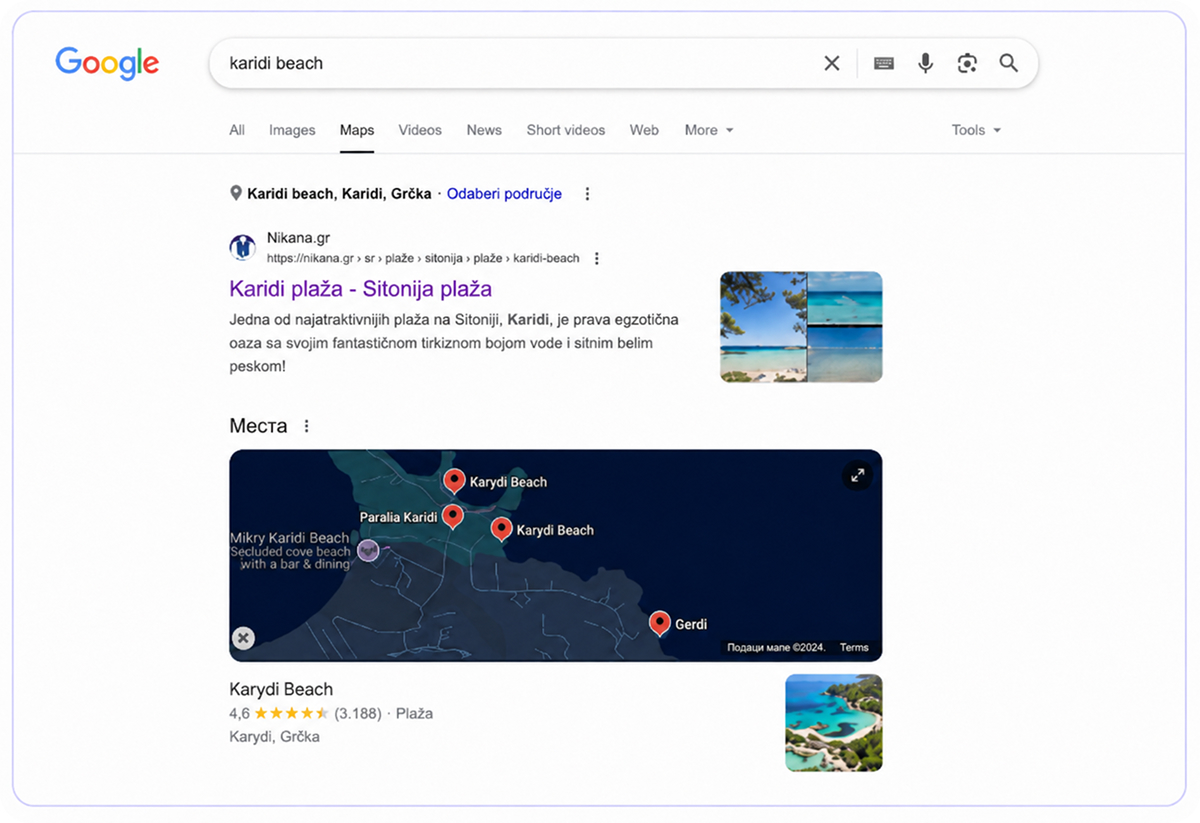
As Nikana is a Serbian brand that targets tourists looking to visit Greece, they mostly use Serbian keywords. Keywords are Google queries that people use for landing pages or content to ensure the algorithm highlights pages when someone enters the queries in the search bar.
Karydi Beach is a popular tourist destination in Halkidiki, Greece. Famous for its fine white sand and striking turquoise water, it attracts millions of beach-goers each year, so it’s easy to assume the name will be Googled fairly often. Knowing this, Nikana created an article or location guide that targeted this particular keyword, and it ranked #1 in the search engine.
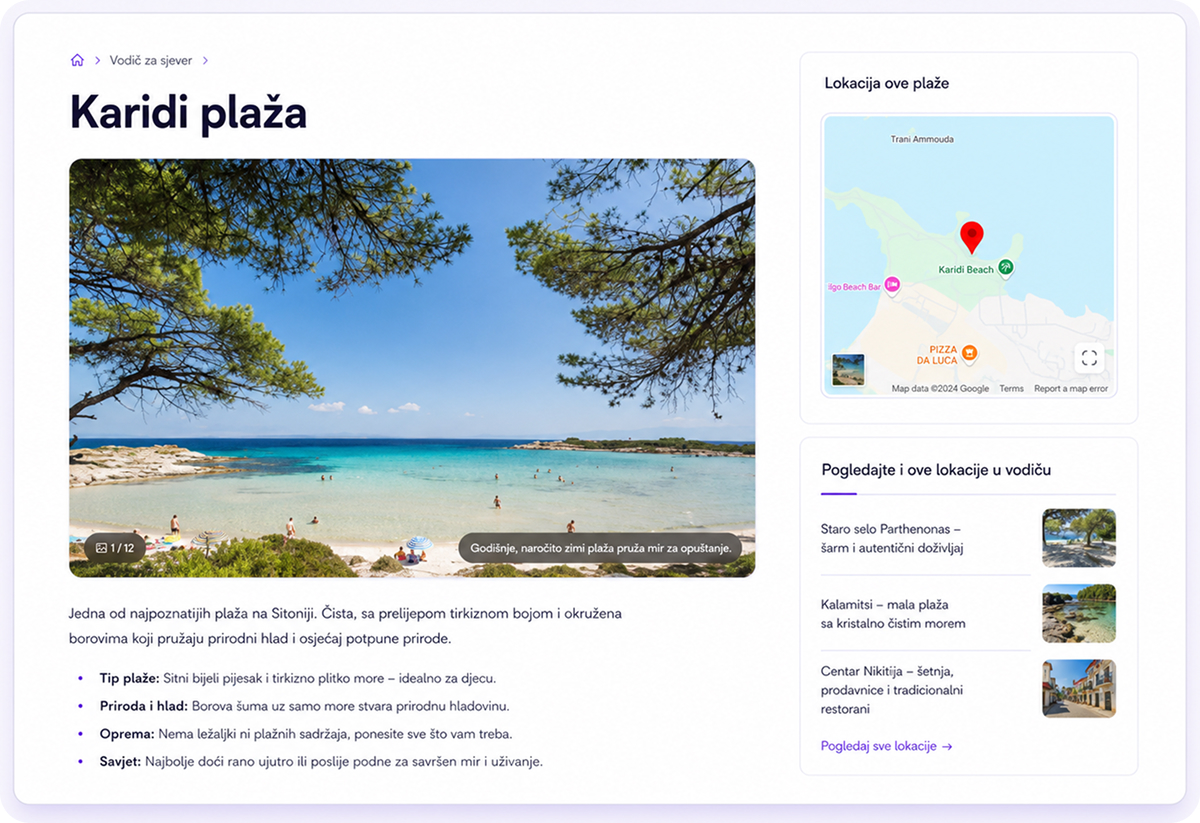
After opening the page, the visitor sees a beautiful hero image and a fairly short text below it. This page is a 1-2 minute location overview that helps the reader make a travel decision. They may read the page and still do some additional research or reach the end, watch the video, and leave the site.

No matter their decision, they will immediately be presented with booking recommendations from Nikana. They’re spread throughout the text and are present at the very end of the guide. The user will make the connection between the brand and their services and will keep them in mind.

If we assume the user left the page, they may come back after comparing options and click one of the links to review accommodations. As the user journey is rarely straightforward, it’s also possible they’ll return through other means or simply Google the brand name.
The important thing is they’re going to review the accommodations offered on the site. And, for that purpose, Nikana provides a vast gallery of images, a detailed description, a quick list of what’s available on the property, reviews, and even a video tour. All those things are immediately relevant to the customer and are very likely to make them convert.
To book an apartment or house, the user will enter their personal information and submit the request. If they pay for the booking, they become an actual client and may be open to purchasing other products. Thus, as a partner, Nikana offers esimba.ai’s eSIMs through targeted email outreach or through WhatsApp messages closer to their arrival date.
That’s how an effective use of the funnel looks. Our partner put meaningful time into execution and ensured each stage was considered. Any person looking for connectivity and accommodations can find their brand, learn about their services, and convert due to transparency and visual presentation.
Revenue growth is reliant on getting recognition for your brand. For eSIM resellers, that usually comes down to a handful of channels that punch well above their weight:
You want to approach channel selection carefully, as you don’t need to be everywhere at once. Start with the one that plays into your existing customers’ interests and behavior. If you’re building it from scratch, a steady source of digital marketing tips helps you keep up with platform changes before you’re ready to bring in an agency.
Beyond general overviews and instructions, we’ve also asked our sales team to provide tips for potential partners. You can find their advice below.
This tip is connected with what we mentioned about channels. As a business, you already know your target audience and are selling eSIMs to the same people. Because you understand the audience, you know how and where they spend their time. That existing knowledge means you don't need to guess at channel strategy or spread your budget thin testing platforms, at least not initially. Start with what you know, and change course only if the same approach doesn’t work.
If a potential customer finds an issue, doesn’t purchase the eSIM, and leaves a bad review, that doesn’t mean they aren’t interested in the product. Acknowledge the concern directly, then respond with a specific answer and provide a solution. If it’s a failed activation, investigate the issue with your team. If the coverage is incorrect, consult your provider and fix the issues within the text.
"Multi-IMSI provisioning" means nothing to most buyers. Explain what you're offering in plain terms, plans, coverage, and savings, so the value is obvious at a glance. If a prospect has to work to understand what you're selling, they'll disengage before they get to the part that would actually convince them.
Share something useful before you ask for the sale: an educational guide, a quick device-compatibility check, a short demo of how activation works. This positions you as a resource the prospect can trust rather than someone just pushing a product, and it keeps the relationship alive even when there's no immediate purchase on the table.
There’s a metric called click depth, showing just how far the user goes on your site. Usually, it doesn’t go beyond 1-2 pages, which means even your potential customers can lose interest in a few minutes. To avoid conversion issues, ensure each landing page is tailored for a specific type of user and contains relevant keywords.
Even working with a well-established partner doesn’t guarantee instant success. Even if it feels like you’re getting everything right, issues aren’t uncommon, and our sales team decided to mention them, too.
Poor support is often the single biggest driver of customer churn and reputation damage, more than price or even coverage gaps. A customer with an activation problem who can't get a fast, competent answer doesn't just leave; they leave a bad review. To fix, build in incentives for your support team tied to resolution quality, not just ticket volume, and run periodic training so the team stays sharp as your catalog and customer base grow.
If your provider doesn't clearly flag which KYC or regulatory obligations apply to the markets you're selling into, you inherit the problem without knowing it exists until customers start complaining or a compliance issue surfaces. Confirm with your provider upfront exactly what's covered on their end. Ideally, work with a provider where no KYC is required from your customers at all, since that removes an entire category of friction and risk.
A batch of eSIM profiles that expire before you've sold them, or that activate the moment you purchase them rather than on first use, can quietly turn inventory into waste. This is easy to miss until you're sitting on stock that's no longer sellable. Confirm expiration terms clearly before committing to volume, and make sure activation triggers on the customer's first use, not on your purchase date.
Competing purely on price is a losing game against providers with different cost structures or risk tolerances. The better path is carving out a niche where you're effectively the only relevant option, a specific audience, destination, or use case, so the conversation isn't about who's cheapest but who fits best.
Instant digital delivery makes eSIMs an attractive target for stolen card testing and fraud, and high chargeback rates can quietly erode margin while also putting your payment processor relationship at risk. A strict anti-fraud system at checkout, flagging unusual purchase patterns, verifying card details, and rate-limiting repeat attempts, isn't optional overhead here; it's a core part of running a profitable eSIM business.
Now that you’re familiar with all the core concepts, you may be looking to start selling. And here, esimba.ai could become the only partner you need to gain a good secondary revenue stream.
We have experience working with diverse business verticals, and already have many years of partnership experience under our belt. We have a capable 24/7 customer support team that can train yours on the approach, provide more than reasonable whole pricing for you to profit, and know how to track activation and payment anomalies, and are experts at regulations and KYC.
If you partner with esimba.ai, you can be sure you’re covering all angles for a successful sale. Reach out today to explore options together!
.svg)
As a global MVNO, esimba.ai, a subsidiary of Keepgo, provides you with the opportunity to offer your customers top-quality connectivity in 150+ countries.
.svg)


