.svg)
Powered by Keepgo
Powered by Keepgo
Published on:
October 7, 2026
Tags:
eSIM
Across our content, we keep hammering on one point: eSIMs are growing popular. For example, GSMA Intelligence already projects their market penetration (total number of devices worldwide) to be 10% at the end of 2026. There are 7.21 billion smartphones worldwide, and you can only imagine the eSIM monetization potential.
However, even if you decide to jump on the trend, millions of businesses will do the same. Fintechs, telecom startups, travel agencies, and platforms, you have to compete with them. But how do you know which path forward is correct, and how can you differentiate and strategize?
We’ll answer these questions in this article, explain monetization models, revenue, and margins, and show you how to start monetizing connectivity.
Let’s start with models. Although each business has its own way to engage with partners, only 3 pathways are really available at any given time.
If you’re looking for the easiest entry point, eSIM affiliate programs are the way to go. You don’t purchase inventory or make any kind of investment. You simply reach out to a provider, get or generate your own affiliate links, and start advertising their products in your content, be it blogs, YouTube videos, or even TikTok reels.
But because you’re not putting any money in, you only ever earn a profit from sales. The link you place drops a cookie, and when a user clicks it, the system starts tracking whether they'll purchase the product. There’s usually an attribution window of a month, and they have to buy it during that period.
The commission is usually 5-20% of the product purchased, and such programs aren’t a good fit for most businesses, unless you’re an eSIM aggregator or a travel-related platform or site with high traffic. They were primarily made for content creators. If you think you can make it work, these programs are worth a try; otherwise, you’re only left with two options.
Becoming an eSIM reseller isn’t as straightforward as it may seem. Between choosing the provider and thinking about how to sell connectivity to your clients, you have to figure out marketing, positioning, and, in most cases, support, as your provider can be quite hands-off in this regard. But let’s take one thing at a time.
To become an official reseller, you need to choose a provider with a reseller program or white-label services. After you reach out and work out a deal, you’ll likely get access to a web platform showing available inventory. For instance, all esimba.ai partners gain access to 4 plans: Unlimited, Travel, Lifetime, and Voice&SMS upon registering. That platform will also be your go-to for multiple other things, including account analytics.
From there, you have two options: you either purchase available bundles and distribute QR codes, or use the provider’s eSIM API (you get a key after registering on the platform) to embed connectivity in your app or website, or even create your own solution. Such platforms work off your current balance and allow you to purchase eSIMs at wholesale prices, with esimba.ai offering 10 and 15% discounts based on top-up amounts.
After you complete the above steps, you officially start reselling. Your provider will share training materials for sales, marketing, and support and will help resolve any related issues, including technical errors if you went the API route. However, you’ll be responsible for everything, and that already carries significant risk. Get things wrong multiple times, plan out the reselling operation incorrectly, and you’re in for a hard time.
Turnkey solutions involve your provider using their own development team to create a custom white-label solution for you. It could be a mobile app or mini app, a web application, or even a custom bridge or agentic flow. You still go through the reseller process, but you save time and money on development.
The main difference between this and the previous model is the man-hours you have to put into the project. Building your own development team can get expensive quickly, and we've already broken down the costs of creating a white-label app. It’s much easier when you know what you’re doing and where to cut costs for a faster development timeline.
Aside from that, the biggest risk factors on top of the usual reseller ones are maintenance and quality. Any eSIM solutions you outsource to your provider are theirs to handle, and if things go wrong on their end, that’s an immediate loss for your business. That’s why you need to oversee development and evaluate the whole process to identify potential pitfalls.
To both summarize, here’s a table briefly comparing the 3 pathways on what matters:
If you decide to start reselling connectivity, the next logical step is to choose your provider, and here you have to consider the following:
Most of these are self-explanatory, since they relate to what we covered above. But one thing often skipped in articles is margins, and that’s what we’re discussing next.
Selling eSIMs makes you money in two ways: you either earn a commission or keep the gap between the wholesale and retail price as profit. Let’s break these down into practical examples:
Although you don’t take on this burden with commission, reselling can incur additional costs. The main reasons are force majeure events, and you may face fraud and customer refund requests, all of which will eat into your bottom line. That said, the numbers provided are for your reference, and our partners usually report a 40-50% net margin, thanks to recurring revenue after the first sale.
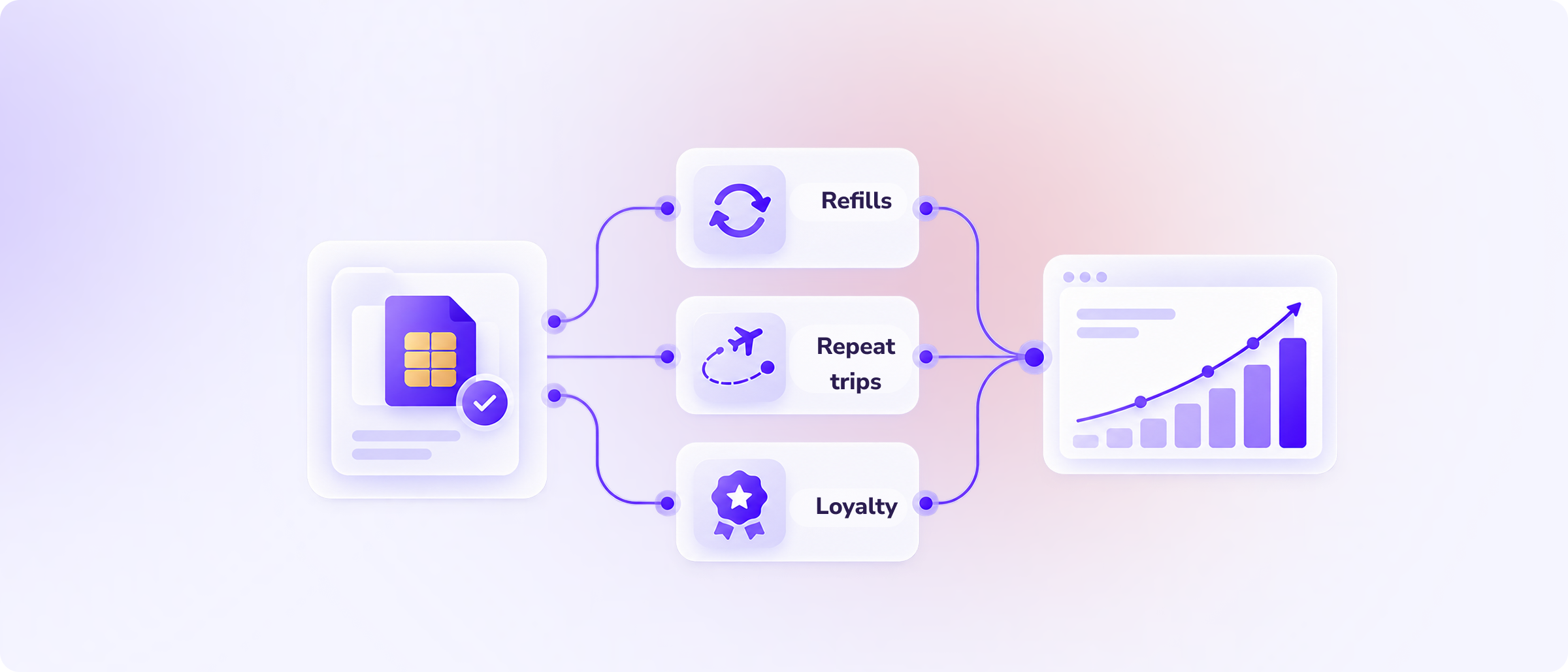
For a reseller, the first-time eSIM purchase is the hardest, but everything gets easier after that. That’s also where eSIM monetization really takes off and becomes a stable revenue source through:
All these tactics help further improve your bottom line and come up with ways to properly work eSIMs into your main offer. Put in enough time and effort, and connectivity will be synonymous with your brand and, thus, even easier to sell.
Now that we’ve covered most of it, it’s time to discuss your competitors. The eSIM market is crowded as is, and if your brand isn’t well-known already, it will be hard to both stand out and sell. In such a case, we’d recommend starting with the selling tips post. These tactics help improve your bottom line and find ways to integrate we created with our sales team.
But if you already know what to do, the only real differentiator will be positioning and your eSIM inventory. If you go and read the copy on any eSIM site, you’ll hear about data, how the cards are excellent for travel, how they help you save money, etc. It’s become common knowledge and will no longer convert a hesitant buyer, especially if there’s no suitable bundle.
To truly stand out, you need to pick a proper niche: students studying abroad, digital nomads, or travelers (corporate or regular). Then ask yourself what kind of plan they’ll be interested in, and see whether the provider you chose offers it. If not, they may be able to help you create a custom plan. Only then can you start writing the text and optimizing the website for search engines.
If, after reading this, you're interested in offering connectivity to your clients, we at esimba.ai are always ready to take on more partners. As a subsidiary of Keepgo, an MVNO with 15+ years of experience, we’ve helped many companies successfully monetize eSIMs and even pSIMs.
We offer 4 distinct data plans, support hybrid eSIM and pSIM strategies, and process custom bundle requests for all our partners. If you top up $500 or $5,000 on our eSIM platform, you get a 10-15% discount. Our team is always available for advice and can provide you with any training materials you need to get started. We offer app, mini app, and web application development services and can even appoint a project lead from our dev team if you need it.
To learn more about how we can help your business sell connectivity, click the button below and fill out the form. We’ll get properly acquainted and help you get started in no time!
.svg)
As a global MVNO, esimba.ai, a subsidiary of Keepgo, provides you with the opportunity to offer your customers top-quality connectivity in 150+ countries.
.svg)


