.svg)
Powered by Keepgo
Powered by Keepgo
Published on:
June 26, 2026
Tags:
eSIM
API
Being a successful MVNO is tough. You have to negotiate with MNOs, get integrated into their infrastructure, and ensure the numbers make sense for it to be your business. For some companies, it takes months; for others, years of hard, dedicated work. We at Keepgo had to overcome a lot before even launching our white-label eSIM platform, esimba.ai.
The good news? Becoming an eSIM reseller is much easier: you partner with a trusted, reliable provider and get into business within a month or less. If you’re browsing options and want to know the process, you’ve come to the right place.
We’ll explore what becoming a reseller entails, discuss partnership models, and highlight each critical step in the process, while providing experience-based tips from years of partnership experience.
An eSIM reseller is a company that gets data plans from its partner, an MVNO, and sells them to its end users. This can be done either through their own brand, or as part of a broader offering
Reselling in the eSIM sector is digital: there’s no physical inventory management involved. Instead, this burden lies with your partner or provider, with whom you usually integrate through an eSIM reseller program.
All this, however, means that practically any company can quickly integrate to start earning ancillary revenue. But only on paper. In practice, the eSIM business model isn’t a great fit for just anyone.
If your customers use older devices or you are operating in a market where eSIM access isn’t supported, then becoming a reseller doesn’t make much sense. The same can be said if:
If any of these seem like a deterrent, it’s best to consider other options, and that’s what we tell all our potential prospects at esimba.ai.
Before approaching any provider, you should plan and consider how to cooperate with them. Many offer eSIM reseller programs with distinct partnership models, and they all differ in terms, conditions, and other minute details.
Many medium-to-large companies integrate through eSIM API: it’s easy, utilizes the resources they already have, and, with good partner documentation, ensures a quick transition. However, some may offer web and app development services, allowing you to create custom solutions without any operational problems.
If you want to know more about partnership models, app creation, and API integration on our white-label eSIM platform, you can follow the links below.
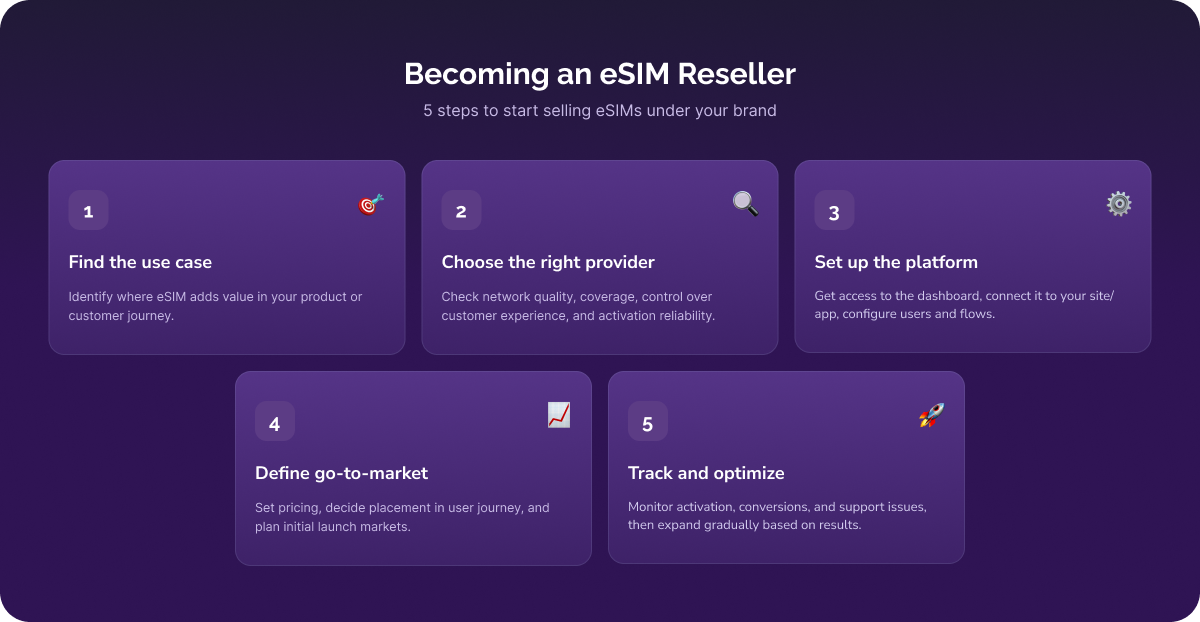
If you’re firm in your decision to become an eSIM reseller and you’ve decided on the partnership model, use the steps below to guide you through the process.
Before signing up for anything, step back and consider the whole picture. Think about where connectivity actually belongs in what you already do.
Try to itentify a specific niche problem your customers have. For crypto wallets, eSIMs could provide an additional layer of anonymity, as their users prefer high-level personal data security. Airlines could offer them alongside tickets, while hotels could do the same during the booking process, helping clients avoid long queues on arrival.
Map this for your business and identify actual pain points that eSIMs solve for your customers.
Tip from esimba.ai: Solving problems for your users reaps the highest rewards. Our two crypto partners cumulatively earned $200,000+ through API implementation. Our other partner, Nikana, made even more by offering eSIMs alongside booking options.
Not all eSIM reseller platforms and providers are equal in terms of capabilities, but they are directly responsible for your customer experience and margins. Before agreeing to anything, evaluate:
Tip from esimba.ai: Ask whether your partner is a direct MVNO or a middleman, request regional network specifics, clarify who owns profile lifecycle management, and find out exactly what happens when a customer's installation fails mid-download. The answers will tell you far more than any sales deck.
The next step is setting things up, and the process differs from provider to provider. If we take esimba.ai, any partner gains access to our eSIM platform. It functions as a dashboard with active lines, bundles purchased, account balance, and other relevant information.
You receive access to your admin account and can connect the platform to your website, and allow your users to sign up. The platform accounts for this, displaying data per individual line a user purchased, and provides the tools to generate sales performance reports. Platform integrations also apply to app-based partnerships.
Tip from esimba.ai: To avoid operational hitches, explore the platform you’re given access to. For reference, ours allows configuring automations, like balance refills, changing webstore inventory and design, or manually getting a QR code. In case your partner forgets, ask for a guided platform tour and keep all the features in mind for the future.
By this point, you have already figured out the essentials, and it’s time to finalize. Start with your pricing strategy. Your wholesale price should set the floor, and everything above is within your direct control. Keep in mind that undercutting the market is rarely a sustainable edge.
Decide how eSIM will surface in your customer journey. Will it appear at checkout, inside an app, or via email at the point of booking confirmation? The placement matters as much as the offer itself. After that, set a realistic go-live scope and launch across markets most relevant to your audience.
Tip from esimba.ai: Ask your provider when deciding on markups. Based on experience, popular high-volume destinations like Mexico, Italy, and the US tend to have lower wholesale costs, supporting markups of 60–75%. Mid-tier markets such as parts of Southeast Asia and Eastern Europe sit in the 50–60% range. Markups tend to be lowest in high-cost markets like parts of Africa and the Middle East, where the range is around 30–50%.
After you’re confident and ready, it’s time to launch. Take full advantage of the partnership program, and make sure you track your numbers.
Start with a small set of metrics and track them consistently. The attach rate tells you how well your offer is placed in the customer journey. The activation success rate tells you whether your onboarding flow is clear enough. Support ticket volume and the reasons behind those tickets tell you where friction still exists.
Use those metrics to make deliberate decisions, and actively consult your partner. Keep in mind that they’re not always at fault, and you can use their experience to help improve your strategy.
Tip from esimba.ai: Resist the urge to expand too early. A 90-day baseline on a focused market set gives you a far more reliable signal than spreading thin across every destination your provider supports from day one.
If you find yourself on step 2 and are looking for a reliable, long-term partner, look no further than esimba.ai. With a proven track record of success, we help travel, fintech, and insurance businesses generate additional revenue through eSIM reselling.
Becoming an eSIM reseller carries lots of risks related to compliance, profitability, setup convenience, and user experience. Partner with the wrong company, and you risk creating user base friction or simply not earning enough to justify the spend.
esimba.ai has helped partners through all such issues, and we’re ready to bring connectivity to even more businesses worldwide. If you’re ready to partner up, reach out to us today.
.svg)
As a global MVNO, esimba.ai, a subsidiary of Keepgo, provides you with the opportunity to offer your customers top-quality connectivity in 150+ countries.
.svg)


