.svg)
Powered by Keepgo
Powered by Keepgo
Published on:
June 22, 2026
Tags:
API
eSIM
Practically any business vertical could benefit from dedicated apps: they drive engagement, are easily accessible, and 90% of user activity happens within them. And although it’s easy to conceptualize one, execution is the true challenge due to high costs, development complexity, and legislation.
If you were planning to gain additional revenue streams, white-label eSIM apps could help. They have already transformed the travel experience by adding more convenience for customers and are now being actively used in other industries. This article covers everything you need to know, including how they interact with white-label eSIM platforms.
.png)
A white-label app is a mobile application that you set up with your chosen partner. You don’t write a single line of code and simply review and contribute to the creation process up until publication.
When it comes to eSIMs, such an app allows your customers to browse destination-based data plans, purchase, and activate them. Behind the scenes, your provider manages network infrastructure, carrier agreements, eSIM provisioning, and support via a platform.
An eSIM platform like esimba.ai allows you to set up end-user accounts. It connects to your app via the admin account and displays data on the most recent purchases, balances, etc.
Mini apps could also be white-labeled. They’re applications embedded into a full-scale app, often called “an app within an app”. On WeChat, around 945 million people actively engaged with them back in 2024, and the numbers are even higher now. Some partners, like esimba.ai, could also help you embed any mini app into your existing ecosystem.
Both white-label apps and mini apps lower the barrier to entry for businesses, fully eliminating the added hassle of overseeing implementation. But in the grand scheme, there are pros and cons for the final result, which we’ll discuss below.
Building an app or mini-app can take anywhere from 6 to 12 months: you need an engineering team, telecom expertise, and full distribution knowledge, with App Store and Google Play compliance. Outsourcing development to your partner optimizes costs and removes responsibility for maintenance, infrastructure management, and testing, not to mention enabling extremely quick app creation.
If you plan on becoming an MVNO, building relationships and managing carriers is a long, complex process. You can sidestep participating entirely with a white-label eSIM partner and gain access to a wide network of carriers across continents.
Custom development comes with high upfront costs (see White-Label App Development Costs). The partner model shifts the burden to the provider, while you spend more time on your product and brand.
Depending on how your partner handles development, customization can be somewhat limited. At esimba.ai, we built an automated pipeline that provides quick turnaround while keeping costs low. The trade-off, however, is that building a unique feature could take a long time, with design elements being your primary focus area.
Your provider will be solely responsible for app or mini-app uptime. If the infrastructure crashes or its operations are otherwise disrupted, your customers can feel the impact. Here, choosing a stable, established partner matters more than it might initially seem.
If you decide to proceed with development, the next decision block is about expenditures. White-label apps tend to cost you significantly less, with a detailed breakdown looking something like this:
Data sourced from White Label Apps and Code Driven Labs
Not a single price range is definitive and depends on your scope, work involved, and the stumbling blocks you encounter during the development process.
Now that you have estimated costs, think about distribution. It’s important to consider early on to establish accurate timelines and facilitate development.
Before your app can go live, you'll need active developer accounts on both the Apple Developer and Google Play Console. These need to be registered under your business name to maintain the white-label integrity of your product. Apple asks developers to pay $99 per year for an account, while Google asks for a one-time-only $25 fee. If your provider is submitting the app, make sure the account ownership and admin access remain with you.
Both Apple and Google review every app submission before it goes live. Review timelines vary, with both platforms taking around 3 days to inform you of their decision. Rejections are possible, and, if they occur, the timeline can extend up to two weeks, with the platforms clearly outlining which changes are necessary after each review.
Not every single device supports eSIMs, and compatibility depends on device model, brand, and other connected factors. Before launch, consult with your partner and create a compatibility list to guide your users.
Your target audience profile is also tied to a region or location. Even if your app is available globally, it doesn’t mean that every eSIM plan will be tailored to their needs. It’s best to be transparent about which regions your plans support.
A launched app is a living product. OS updates, new device releases, and changes to app store policies all require ongoing attention. It’s important to factor maintenance into the budget and confirm if your partner can provide support in this regard.
If an issue occurs, the customer will contact your support team. Make sure they understand the activation process, common failure points, and how to escalate relevant issues. Your partner should also provide you with training materials.
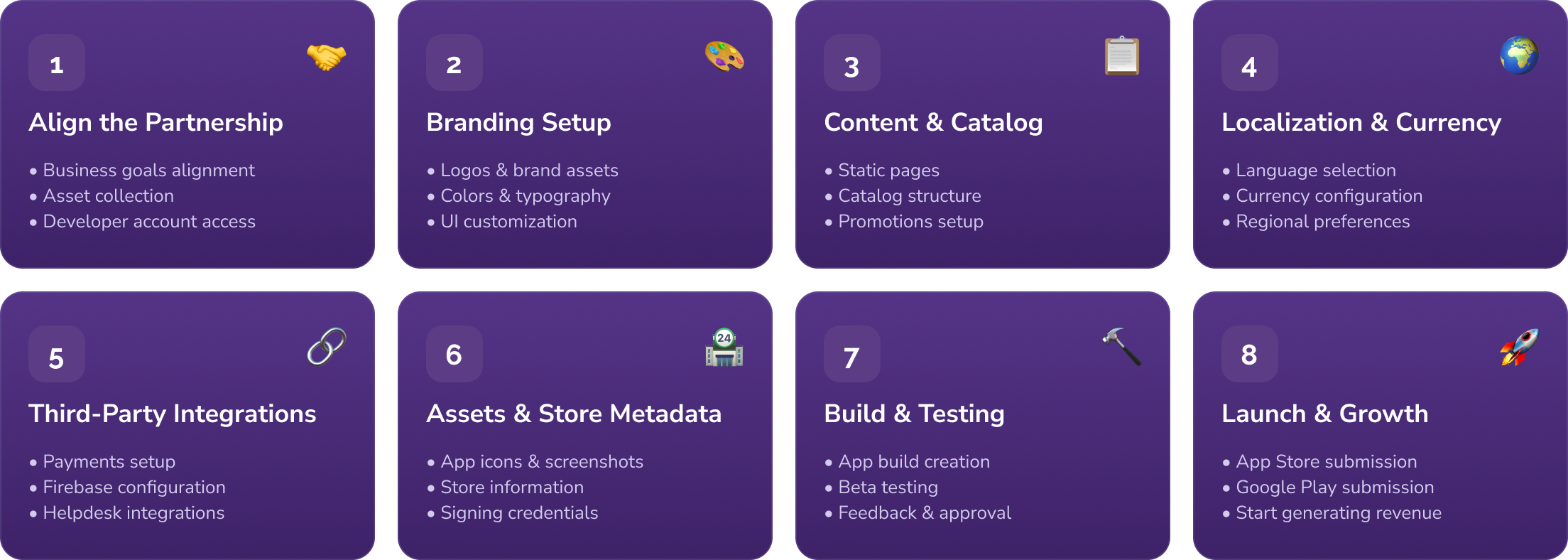
Development typically covers five key areas: partnership setup, app creation, testing, distribution, and maintenance. At esimba.ai, the process kicks off with an initial sales call followed by discovery, goal alignment, and asset collection, after which you grant access to your Apple Developer and Google Play Console accounts.
From there, you customize the app's look and feel by providing logos, color palettes, and typography, then configure content like static pages, catalog structure, and promotional carousels. Localization and currency settings let you support up to 10 languages and multiple currencies, while third-party integrations handle payments, analytics, push notifications, and optional helpdesk tools like Re:amaze, all tied to your accounts and brand.
Once the configuration is complete, we gather your signing credentials, generate the necessary certificates, and set up all store assets. We then run initial testing and release a beta via TestFlight for your review. After approval, we submit the app to both stores for policy review, and once cleared, your app goes live and is ready to generate revenue.
All in all, the entire process, with all steps included, takes up to 21 days, or 3 weeks, which is faster than any other option available for you.
Most white-label eSIM reseller programs offer API access as their primary partnership model. You call the API to retrieve plan inventory, trigger activations, get status updates, and manage balances. However, the app framework, the user interface, and the development resources are yours to handle.
This works well for large businesses that already have a development team. But if you’re a small-to-medium company lacking in-house resources, an app could allow for better market differentiation. esimba.ai has already built custom webstores and helped many partners integrate through reseller programs. More recently, we also started offering full app development services through our App Factory.
App Factory is a newly built automated framework that allows any partner to get an app within 21 days. We’ll create the code infrastructure and assist with publishing, ensuring full Apple Store and Google Play compliance. We’ll also handle maintenance and updates and can guarantee that only 5% of pushed changes will require your participation.
The pricing for the service is custom and discussed on a case-by-case basis. For existing partners, we can offer free development if their monthly turnover is $3,000.
If you’re looking for an easy white-label eSIM app entry point, there’s no other similar solution available. To discuss options and learn more, reach out to us at esimba.ai.
.svg)
As a global MVNO, esimba.ai, a subsidiary of Keepgo, provides you with the opportunity to offer your customers top-quality connectivity in 150+ countries.
.svg)


