.svg)
Powered by Keepgo
Powered by Keepgo
Published on:
June 3, 2026
Tags:
eSIM
API
Telecom
Opening or planning to open your own eSIM webstore, or integrating eSIMs into your offering, is a natural response to growing demand. A general shift from pSIMs is already happening, and many smartphone models don’t even have a physical slot. The market itself grew by ~19% to a current valuation of ~$2.12 billion, with projections indicating an increase to $7.62 billion by 2034.
As a business or potential startup, you’ve probably considered capitalizing on the trend. The issue is working out the fine print, such as integration costs, branding, margins, and sales tactics. The most straightforward way, however, is to look to white-label eSIM reselling.
At esimba.ai, Keepgo’s white-label eSIM platform, we have already partnered with many airlines, travel agencies, crypto and insurance companies, and even fellow MVNOs, expanding their revenue streams. Through the platform, we established mutually beneficial processes and helped businesses seamlessly integrate eSIMs into their offerings.
And if you’re currently looking into white-label eSIM platforms, this guide is for you.
A white-label eSIM platform is a toolset from your provider to sell eSIMs with zero physical infrastructure. You’re not building your own telecom brand, and there are no carrier negotiations and no network management. Instead, you simply establish a partnership with an MVNO and use a platform like esimba.ai to either create your store or to integrate eSIMs into your offerings.
After creating an account and establishing a partnership, you become a reseller and gain access to eSIM bundles, wholesale prices, and the store API and resell them under your own brand. Usually, the platform itself provides the rails, and you work on your brand strategy and pricing.
Each platform establishes its own partnership terms. As an example, at esimba.ai, we usually engage potential clients and offer them six distinct types depending on their current needs.
You purchase the eSIMs through your partner account and distribute them manually (i.e., through tour guides) along with installation instructions, either for your customers or employees.
If you have a standalone developer team, you can integrate through our API. You usually choose between a Light API, which requires fewer commands and is best for one-time eSIM purchases, and a Full API integration, offering a complete service cycle, including eSIM search, purchasing, and management.
You get a full eSIM webstore, customized with your branding. This includes a functional webstore front, a login/signup functionality, and allows you to host user and admin accounts, with the ability to get wholesale prices and set your markups.
Functionally similar to a full webstore partnership, with the same benefits applied. The only difference is that we manage all the processes, and you earn a commission based on sales.
Usually offered as an add-on to our webstore partnership, the white-label eSIM app gives your customers a native experience on iOS and Android under your name and design. Setup is fully no-code, with integrations and technical issues handled by us.
A lightweight application that runs with your app. Very lightweight, and doesn't require the user to install it or register a separate account.
As a business, before engaging with any potential white-label solution, you need to understand the mechanics working behind the scenes. It can prove useful for scaling and optimizing your revenue stream. As before, we’re using our brands as examples.
It all begins with structure, and there are four distinct layers:
The purchasing process is quick and simple:
After signing the partnership agreement, there’s a clear division of labor. Each partner has their own responsibility zone, but some confusion is common for newer resellers.
You control everything that relates to marketing and sales. You manage branding and customer-facing experience, pricing, marketing, customer acquisition and relations, and revenue and margin decisions.
esimba.ai controls what you might call the backend. We handle carrier agreements, eSIM profile delivery, platform uptime, security, and regulatory compliance. We may also provide some assistance with sales.
Much like the partnership choice, this depends on your business needs. But as with any solution, there are industries where becoming a white-label eSIM reseller could benefit you the most.
Key benefits:
If you serve travelers, then eSIM is a natural add-on. You can offer instant connectivity as part of your existing customer journey. You can purchase and distribute the QR codes, integrate with the API (refer to Nikana), or even let your provider create a designated webstore.
Key benefits:
eSIMs turn your platform into a source of everyday value. You add a practical, high-demand service and, in return, improve UX through the additional layer of security eSIMs offer.
Key benefits:
Many smartphones don’t have SIM slots, and early adoption means future wins. The faster you ditch pSIM logistics, the better, as you can significantly increase coverage. Differing partnership models allow.
Key benefits:
eSIMs can also provide company-wide benefits, giving your team reliable and reasonably-priced connectivity anywhere in the world. No manual top-ups, no juggling multiple providers. Everything is managed “under one roof” and on your own terms.
As we’re rapidly moving away from pSIMs, manual distribution is uncommon. Instead, most businesses are looking for either an app, a webstore, or an API solution for easier integration and faster setup. The difference between these three, however, isn’t always so clear-cut, and choosing can be difficult.
Works for: Entrepreneurs, travel brands, and businesses that want a fast, professional launch without technical overhead.
Getting a webstore hosted on your domain is the natural choice if you need a quick-to-launch solution. You don’t need a development team to manage your infrastructure or even worry about the technical side of eSIM delivery. But you will fully depend on your provider for connectivity and any platform-level changes, which, of course, means limitations when it comes to working with other providers.
Works for: Tech companies, platforms, and businesses that want full control over the customer experience, or those building eSIM connectivity as a feature within a larger product.
If you already have the infrastructure basis and a development team, you can choose to integrate. With the API, you control the entire user experience while the provider takes care of the backend. In terms of flexibility, this is your best option: you can more easily work with other providers and customize every inch of the user journey. However, it’s substantially more expensive due to the development time involved and the future maintenance costs.
Works for: Resellers targeting mobile-first audiences or building a consumer brand around travel connectivity.
A white-label eSIM app pairs really well with your business, provided you already have a storefront. You give the customer a fully native mobile experience and retain trust and loyalty. It's the most complete out-of-the-box offering for resellers who want to compete with the look and feel of established eSIM brands from day one. Although commonly costly, with complex integrations and long development, you can look into no-code options or ask your provider.
The next question commonly asked by potential resellers often boils down to this: where does the money actually come from? The answer is very straightforward and depends on which platform you end up choosing and how you’re going to organize the process.

The next question commonly asked by potential resellers often boils down to this: where does the money actually come from? The answer is very straightforward and depends on which platform you end up choosing and how you’re going to organize the process.
You buy eSIM data from your provider and sell it to the end users at a markup. For the most part, all white-label eSIM platforms, including esimba.ai, let you set your own retail prices. But there may be exceptions, and you’ll have to work with a fixed rate instead, which directly affects your profits.
Margins vary by location, data volume, and how competitive you want to be. Popular destinations, like the US or Canada, tend to have higher ones. How you package data also matters:
Recurring revenue is functionally the same as margins on data sales, but restructured. Frequent travelers or businesses don't want to repurchase connectivity every time they need it. Auto-renewals and top-up triggers solve that problem for them while giving you a reliable, forecastable income stream.
If a platform you're evaluating doesn't support renewals or top-ups natively, treat that as a meaningful operational gap. Customers who run out of data and can't easily top up don't stay customers for long.
Beyond selling data or bundles, you have additional revenue opportunities. As an example, you could upsell your customer base and start creating higher-tier plans with premium speeds or large regional bundles. Or, with an API solution, integrate eSIMs into the broader product through a subscription or service fee.
All additional revenue streams like these are ancillary and could be a great source of income if you’re planning for a long-term partnership.
Before taking the final plunge and choosing a partner, you need to be aware of associated issues and risks. And there are quite a few important ones when it comes to eSIMs.
Pricing is important for a reseller, and, unfortunately, most tend to benchmark against cheap competitor options. This leads to very low, sometimes even borderline unprofitable, margins and occurs because businesses don’t account for their costs.
Here, good advice would be to know your costs from the bottom up and understand what constitutes the final price. Keep in mind that if your bundles or solutions work well, people may pay extra for convenience, and it doesn’t make sense to instantly match competitors, whose offerings may not be up to par.
eSIM support isn’t universal. Not every device handles activation the same way, and customers who run into problems will come back to you for answers. If you haven't tested compatibility across the most common devices your audience uses, you're creating problems for your support team.
The only real solution is to ask your partner for compatibility information. At esimba.ai, we maintain an updated list of eSIM-compatible devices and ensure the partners' end users can always check if theirs is in it before purchasing an embedded SIM.
Data privacy and payment security aren't the most exciting parts of launching a business, but they certainly can shut one down. Depending on where your customers are based and how you handle payments, you may be dealing with GDPR obligations, PCI DSS requirements, or both. And even though your provider handles compliance, they can’t be responsible for everything.
If you’re sending marketing emails without opt-in consent, don’t have a documented process for private data deletion, or store raw card details on your servers, you’re not complying with the regulations. So, run through your compliance obligations early, ideally before you start processing payments or collecting customer data.
Now that we've covered the partnership essentials, it’s time to choose exactly who you want to partner with. If you have accounted for all the problems above and need some guidance, consider the following before making a choice:
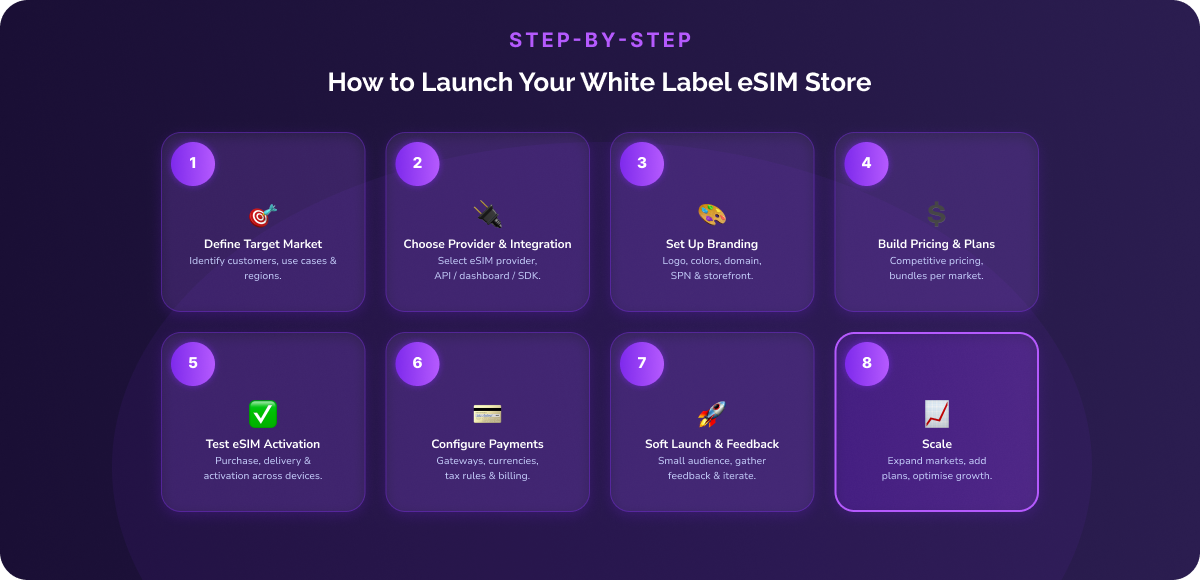
After establishing a partnership and choosing your model, it’s time for action. The process is straightforward for all partnership models and depends on internal business procedures. Out of all of them, web stores get asked about a lot. To that end, here’s the process broken down into eight steps, from the beginning to the end:
By this point, you have a clear picture of what a white-label eSIM business looks like. The last piece is finding a platform or partner that actually delivers on all of it, and esimba.ai was built for exactly this task.
Our platform covers everything you may need: deep white-label branding, transparent pricing, flexible integration, wide network coverage, and even AI-enhanced 24/7 customer support. Our approach is tailored to your business, ensuring you have everything you need to launch, grow, and succeed.
If you’re ready to take the next step, get in touch with us. We’ll assess the potential for a mutually beneficial partnership and, if there’s a match, figure out which setup makes the most sense for your business.
.svg)
As a global MVNO, esimba.ai, a subsidiary of Keepgo, provides you with the opportunity to offer your customers top-quality connectivity in 150+ countries.
.svg)


