.svg)
Powered by Keepgo
Powered by Keepgo
Published on:
July 6, 2026
Tags:
eSIM
MNO and MVNO
Connectivity is changing, and eSIMs are coming to the forefront as the next generation of phones has no SIM slots. Subscriber identification is fully digitized, and switching between different networks is the norm, which means traditional ways of doing things are slowly growing obsolete.
This matters for MNOs and MVNOs who are still adapting to changing market conditions. In 2024, travel eSIMs averaged $5.50 per GB compared to $8.57 for traditional international roaming, and subscribers are becoming increasingly aware of this gap, leaving no option but to alter the approach. But let’s have a look at things more thoroughly.
Both MNOs and MVNOs face a consistent set of challenges:
Although insignificant in isolated cases, the more customer complaints and support tickets you receive, the more difficult it will become to retain loyalty. And there’s actually some concrete evidence to back up this claim.
When a subscriber pays $9 per GB and loses connection in a foreign country, they certainly become frustrated. Customer experience data points collected from Deloitte, Ericsson, Statista, and other sources indicate average support response time is 7 minutes. In some cases, it can extend to 20, but what matters is how the customer feels about the process.
90% of telecom customers report at least 1 outage monthly, and they reach out to the support team for questions. Because 65% of them say they’d choose a provider with slightly worse internet speed but better customer service, we can clearly see there’s an overall issue with perception and support provision.
The experience around such problems is something subscribers judge immediately. Depending on urgency, a slow or unhelpful response at that moment does more damage to the operator relationship than the original connectivity issue. And that experience directly ties to the products and services.
Because of this general shift and support perception, global roaming revenue is declining: from $16 billion back in 2025 to an estimated third of this value by 2030. Nearly 35% of all international trips will involve the customer buying an eSIM. The reason is simple: cost-effectiveness.
eSIMs remove the need for a physical card with low memory capacity. Instead, you get a microchip that can store multiple IMSIs and maintain a connection during local breakouts. Pricing, even with markups, can be set closer to what the market actually bears, and subscribers can activate a plan before they land rather than scrambling for a local SIM at the airport.
Additionally, many eSIM providers are already offering voice and call capabilities. Their data bundles are still cheaper than traditional options and continue to erode the difference between physical and digital cards.
For MNOs, platforms or providers that support hybrid IMSI models allow them to use their own where pricing is competitive, and others where it isn’t. This partnership widens coverage at better rates and doesn’t violate any commitments. MVNOs, on the other hand, enjoy a competitive advantage through better pricing if their host network doesn’t offer favorable roaming agreements.
Because offering entirely new products and services to fit the demand can be challenging, MNOs and MVNOs often partner with white-label eSIM platforms. The partner platform handles eSIM provisioning, network coverage, profile management, and, in many cases, support operations. The operator sets the pricing, designs the bundles, and owns the customer relationship.
How it works in practice depends on what the operator currently needs. At esimba.ai, we usually propose API or white-label apps. API is convenient if you have a dev team on standby; apps allow for stronger differentiation and won’t cost you much thanks to our efficient pipeline.
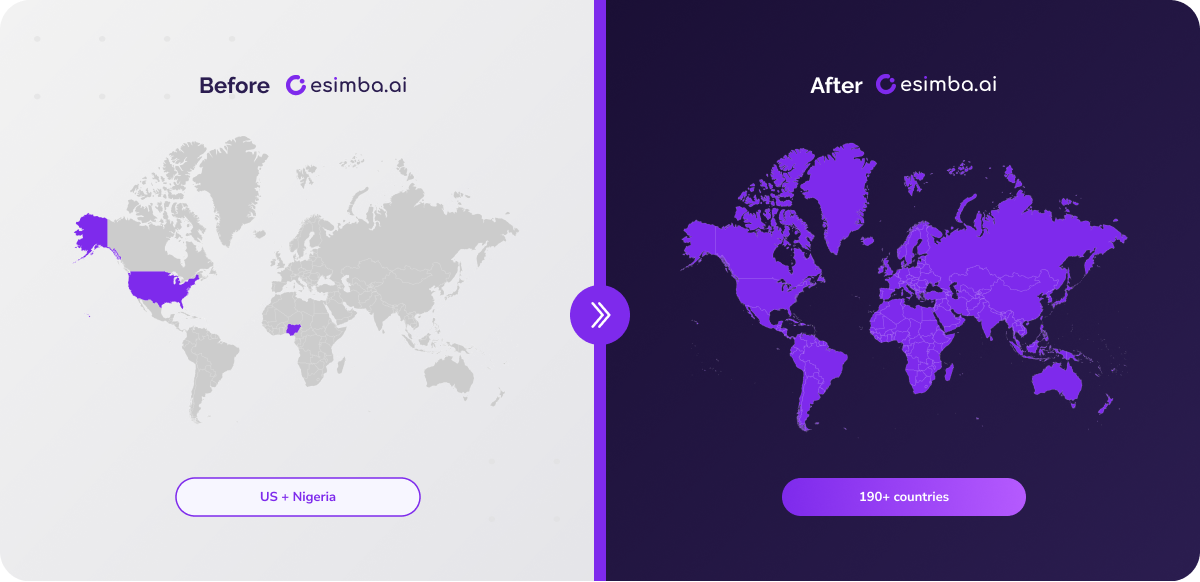
Although MNOs and MVNOs can partner with their fellows, is there actually ground for mutually beneficial collaboration? There is, and esimba.ai can prove it by presenting a partner case for Univasa.
Unviasa started as a regional MVNO operating in the US and Nigeria. Headquartered in Lekki, Lagos, they focused on providing affordable internet and IT solutions in West Africa, building strong technical expertise and a reputation as a reliable telecom and infrastructure provider.
At its core, Univasa was a regional telecom business with diversified services across connectivity, voice, SMS, and enterprise IT support.
As Univasa hadn’t employed eSIMs at the time, they faced typical technical challenges:
After contacting us at esimba.ai and spending some time discussing the issues, we’ve decided to reposition the brand and have immediately launched the eSIM initiative with the following goals:
To help them achieve these goals, we integrated our API for eSIM provisioning. It easily integrated with Univasa’s ecosystem and enabled them to set up custom payment gateways to support regional payment methods.
The API integration went successfully, and eSIMs managed to overhaul Univasa’s strategy. They became a brand with a global presence, and eSIMs started to drive revenue for the company. Because their core offerings were diversified, we were able to secure partnerships with the Federal Airports Authority of Nigeria (FAAN), Wakanow (travel platform), and other airlines and travel platforms.
With coverage extended to 190+ destinations and no reliance on local infrastructure, Unvisa positioned its brand at key travel touchpoints. This enabled them to significantly improve profits and scale internationally, turning eSIM into a globally replicable revenue and distribution product.
We’ve built an effective white-label platform for our customers, and this is one of many examples of the inherent value esimba.ai provides. Our partners enjoy all the core features: analytics, automations, performance tracking, and line management. Zero-friction integration means you’re not obligated to use our products, but if you want to, it will be perfect for embedding it into an existing ecosystem.
MNOs and MVNOs could buy our bundles at wholesale rates and sell them under their own brand. They could also take advantage of the multi-IMSI setup to prevent local breakouts, or even aim for something more bespoke, like a miniapp or a full-scale white-label app developed in just 21 days.
We are pretty flexible as a partner, and this extends to every step in the process, including other providers you may be working with. To learn more about available options, reach out to us at esimba.ai by clicking the link below and submitting a form. We’ll be happy to help!
.svg)
As a global MVNO, esimba.ai, a subsidiary of Keepgo, provides you with the opportunity to offer your customers top-quality connectivity in 150+ countries.
.svg)


