.svg)
Powered by Keepgo
Powered by Keepgo
Published on:
September 30, 2026
Tags:
eSIM
Very often, businesses want fast implementation. Time is a valuable resource, deadlines matter, and every new initiative needs to follow a strict schedule. Everyone knows this, and that’s why SDKs were created.
If you’re new to this, you may have heard of an API, which acts as a communicator that allows two different programs to exchange information. An SDK is different but related, and it drastically speeds up development if you’re not aiming for a custom solution. You use a pre-built one and enjoy the results.
But as to the actual difference between the API and SDK, what the latter is composed of and involves, that requires more elaboration.
Broadly speaking, an eSIM SDK is a set of pre-built tools, code libraries, and documentation that allows developers to add eSIM provisioning and management to an app, platform, or storefront without writing that logic from the start. For example, embedding an eSIM mini app into a super app.
The same logic applies to the eSIM provisioning, which your provider offers through the SDK. Following the previous example, once you update your super app, the mini app will automatically let you purchase eSIMs, monitor usage, manage all currently registered users, and more.
If you’d like a more practical example, let’s discuss how and why SDKs save developers time when building an eSIM app by looking at what they can includ.
No matter which OS you use, iOS or Android, both systems have native APIs for installing an eSIM profile: EuiccManager and CTCellularPlanProvisioning. Neither is open to just any app, though. Apple restricts CTCellularPlanProvisioning to apps holding a specific carrier entitlement, and that entitlement is issued to your app's own App ID, not to a library bundled inside it. A third-party SDK can't carry it on your app's behalf, no matter who the provider is. Android gates its equivalent calls behind similar carrier privilege.
SDKs also include what you actually integrate: a packaged library, a Gradle dependency on Android, a Swift Package Manager or CocoaPods framework on iOS, sometimes a React Native or Flutter plugin. You initialize it with credentials the provider issues. Around that sit pre-built screens for activation and purchase, documentation, and usually a sample app.
Once you know what an SDK is, the next logical question is how it compares to the API. In simpler terms, an API acts as a raw connection point: a set of endpoints your developers call to request a profile, check status, and so on. An SDK wraps the same kind of calls in ready-made functions, so a dev team doesn’t have to do everything from scratch.
Here’s a comparison table to better demonstrate the difference:
As is evident from the comparison, neither option is better than the other. You either trade off flexibility for faster deployment, or spend more time on development to build something that suits your needs. The only real alternative, which may also be cheaper if no SDK is available, is to allow your provider to create a custom solution, and we at esimba.ai can help with that.
Not every SDK is a good fit for your goals. Before choosing a provider and starting to deploy the solution, you should consider:
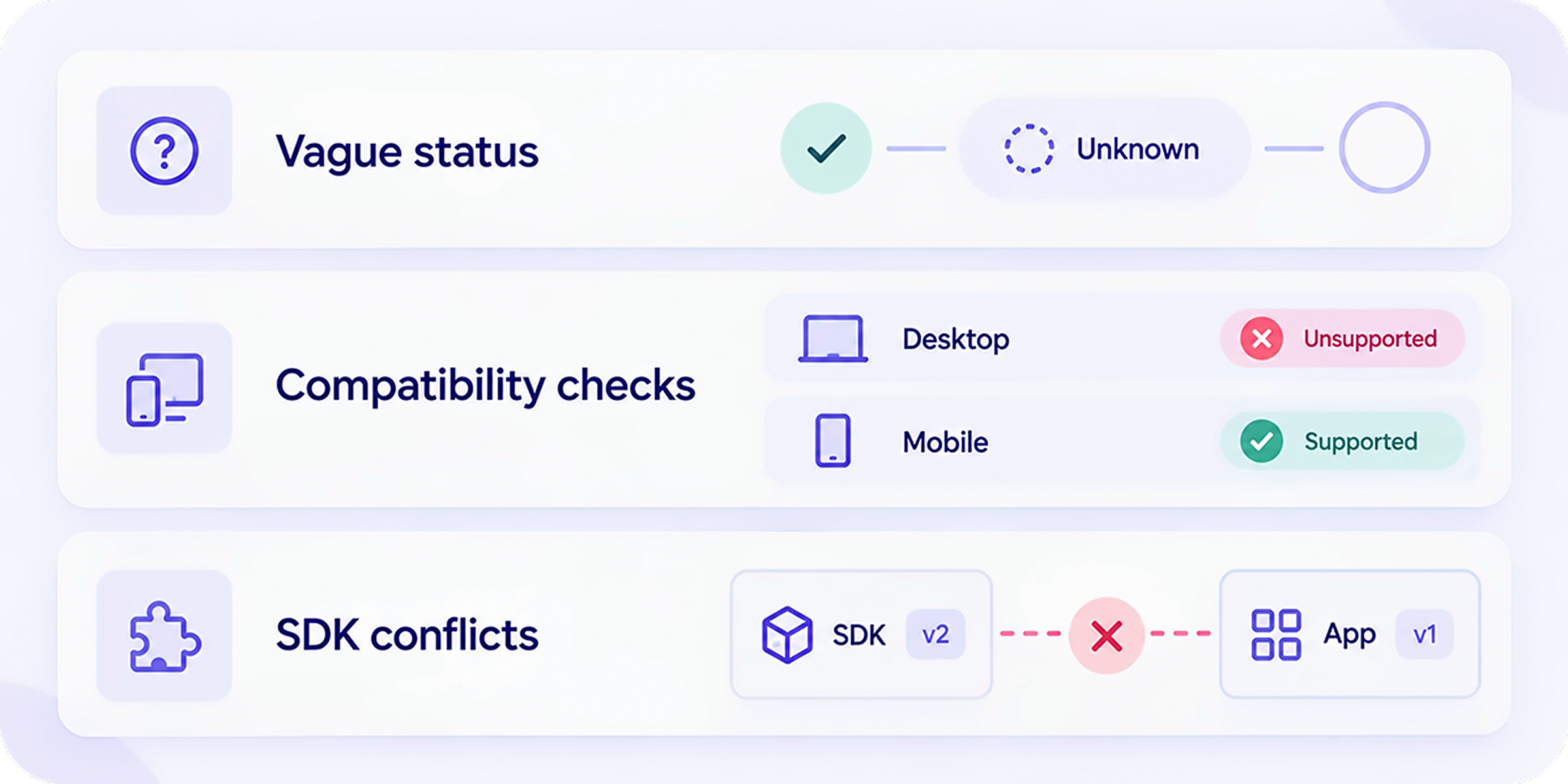
After you’ve chosen a provider and started implementing an SDK solution, you can easily run into certain issues. Keep in mind, these are “expected” issues and don’t always mean your provider did something wrong. You can also fix them quickly by reporting them or seeking provider support.
One of the problems could be status reporting. The SDK simply doesn’t indicate exactly what happens, and, for instance, Apple’s own framework can return an “unknown” result before setup is done. You could also experience unspecified activation issues, with both problems having a single clear cause: the SDK knows more than it’s telling you. If you experience anything like that, bring it up with the provider.
Although any SDK should check whether a device supports eSIMs by default before purchase, the underlying process can be unreliable. Sometimes the query can be a bit slow, and devices that fully support eSIMs can come up as incompatible. Because client experience is a priority, the process should be fixed, and it’s crucial to resolve this with the provider.
Because an SDK ships as packaged code rather than a call to a remote server, it brings its own dependencies and build requirements. eSIM SDKs commonly bundle several third-party libraries at fixed versions to keep their own build stable, which means a later update to your app's dependencies can conflict with what the SDK has locked in place. You'll need to account for that on your end.
If you’re looking for a reliable provider with 15+ years of B2B experience, esimba.ai is here to lend a helping hand. We offer a vast array of premium eSIM solutions that will allow for speedy integration and equally fast profitability.
All visitors can access our API documentation and create a free account on the platform to test the purchase flow. SDKs aren’t the only way to a quick solution, and we provide development services that help create apps, mini apps, web applications, or webstores on a tight schedule. Everything is done quickly; the pricing is fully competitive, and you don’t have to worry about integration at all.
If you’re looking for a fully white-label solution, reach out to us today by filling out the contact form on the site.
.svg)
As a global MVNO, esimba.ai, a subsidiary of Keepgo, provides you with the opportunity to offer your customers top-quality connectivity in 150+ countries.
.svg)


