.svg)
Powered by Keepgo
Powered by Keepgo
Published on:
October 7, 2026
Tags:
MNO and MVNO
We’ve already discussed the difference between white-label MVNOs and eSIM resellers. In brief, neither owns the telecom infrastructure, data centers, or complex systems; the main difference is the legal, compliance, and maintenance work that goes into being an actual provider and business focus, whereas resellers treat connectivity as a secondary revenue source.
However, if you see connectivity as your core business focus, there’s a newer way to fast-track to an MVNO model: creating your own white-label telecom brand with MVNE (Mobile Virtual Network Enabler) support. Instead of treating connectivity as ancillary revenue, you build your entire brand around it. In this article, we'll cover the specifics and show you how to do it right in 2026.
Your white-label MVNO business will look like one company to your customer: your logo, app, and prices. Behind the scenes, though, three or four businesses will handle different parts of the service. Here’s who does what:
Structurally, the entire eSIM purchasing process would work like this:
There’s a certain gradation to being an MVNO, and not all of them are made equal. In fact, some MVNOs are so close to simply being resellers that it’s almost impossible to tell the difference. However, there are three main types, and they can be compared as follows:
White-label MVNO is where you begin with what esimba.ai or any other provider offers. We run the tech backend and maintain any solutions we build, and you own the brand, pricing, and customers.
Light MVNOs take over billing and control how usage is priced and invoiced. However, Full MVNOs run their own core network and issue their own SIMs and eSIMs. They get the most control, but they also need an actual telecom team, which is a running cost that requires serious investment.
You start with minimal responsibilities and can gradually expand over time, building toward a full MVNO. If that’s the goal, the road will be full of obstacles, but they’re manageable, especially if you do things successfully with a white-label model.
A white-label MVNO model gives you a real telecom brand from day one, without the years and capital it takes to build one from scratch. But it offers significantly more benefits than that:
The costs vary by platform and provider. Setup fees may apply, and wholesale rates can vary by provider. As listing the terms for others is a long and daunting task, we can talk about how we do things at esimba.ai instead.
We have very minimal setup fees for becoming a white-label MVNO and never charge for API access. You can register and test everything we offer before committing to an agreement, and you can even upgrade your account to partner status yourself. The only real requirement is to top up your account balance by a certain amount (individual for each partner) to unlock wholesale rates.
Any other cost is entirely optional. We do offer app development services, and if you, for instance, create an app with us, you’ll pay an initial creation fee and be charged a monthly maintenance fee.
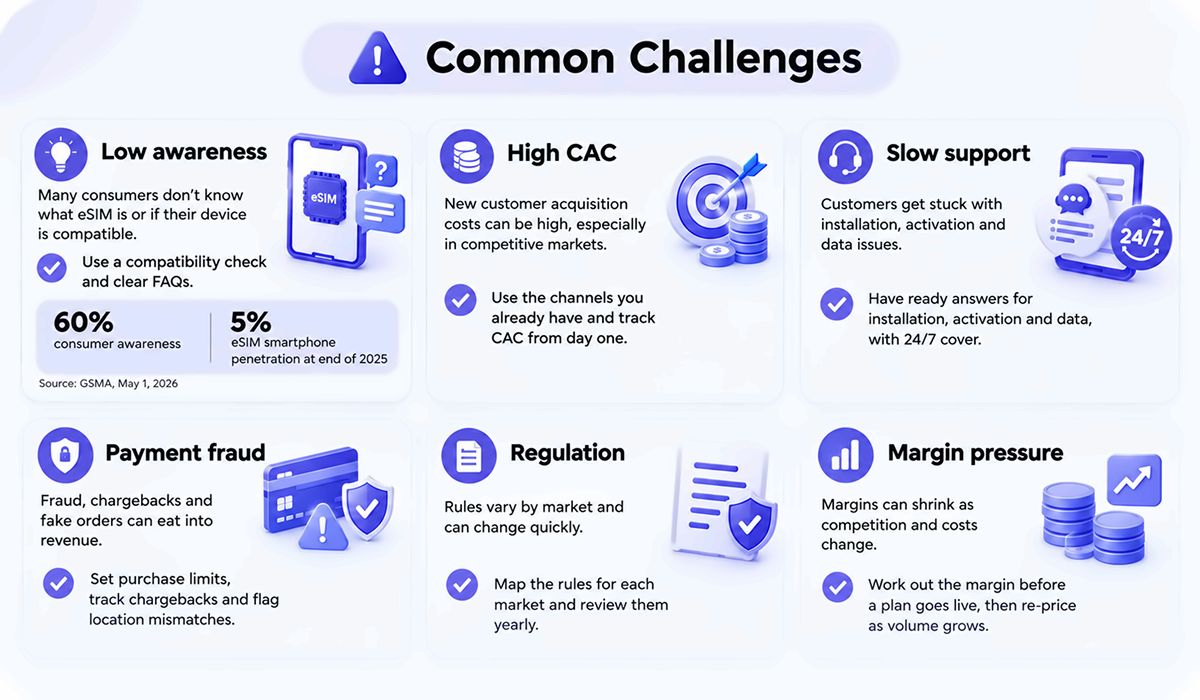
Now that we’ve discussed costs, it’s important to underline that running your own telecom brand comes with certain hurdles. You can't resolve all of them quickly, but with proper guidance and foresight, you can navigate them gracefully.
On May 1, 2026, GSMA reported a rise in eSIM consumer awareness from 25% to 60%. Despite that, eSIM phones made up only about 5% of smartphone connections at the end of 2025. That means some buyers will still be dealing with digital cards for the first time, and adding compatibility checks and FAQs could help reduce potential refunds.
As resellers, you can sell to an existing customer base, but it’s a different story when you’re starting from scratch. Paid ads can quickly eat into your margins, and it may take a while for your site to start generating traffic naturally. See if you can use a pre-existing business, app, or other channel to advertise the new venture, and track CAC from day one.
As a white-label MVNO, all clients contact you first, not your provider. Use your provider’s white-glove support services or build your own team from the beginning. Prepare answers to common questions (installation, activation, and data usage) and ensure you have a solution ready to handle every support request 24/7.
Because eSIMs are delivered instantly, fraudsters can use stolen cards, and orders can result in chargebacks. To counter this, set purchase limits, track chargebacks, and watch for location mismatches to flag suspicious orders.
As an eSIM provider, you should comply with certain regulations. Generally, your provider handles them, but it's best to map the requirements for each market. As rules and fees change, review them annually.
Wholesale costs, marketing, and what customers can afford affect your profits and margins. That’s why you should work out the margin on every plan before it goes live and review your pricing as your volume grows.
If, after reading this, you’re interested in becoming a white-label MVNO, esimba.ai is ready to support you on your journey. You’ll get coverage in 150+ countries across 500+ networks and a partner who fully understands your needs.
As an MVNE, we’ll fully equip you with the means to sell connectivity solutions. We’ll help with strategy, provide recommendations, and even help you develop applications if needed. If you don’t have a developer team and you’re planning an integration, we can also appoint and lead a team from our side to ensure everything is done according to your specifications.
With a wide product inventory and four plans available to partners, you will have everything you need to start selling connectivity successfully. We’re always ready to discuss potential collaborations, and if you feel ready, reach out to us by clicking the button below.
.svg)
As a global MVNO, esimba.ai, a subsidiary of Keepgo, provides you with the opportunity to offer your customers top-quality connectivity in 150+ countries.
.svg)


