.svg)
Powered by Keepgo
Powered by Keepgo
Published on:
September 18, 2026
Tags:
eSIM
Telecom
As eSIMs grow more popular, businesses are leaning toward offering connectivity to their audience. Getting started is easy: you don’t need much capital, and the only real requirement is a reliable provider backing your endeavor. That can get many business owners interested, and they’ll start researching.
During that research, they’re likely to find two terms: MVNO and eSIM reseller. Based on description alone, they may sound similar, as both repackage and resell connectivity. They also imply you don’t own any telecom infrastructure and rely on others to sell eSIMs successfully. Yet, you do need to partner with an MVNO to become a reseller, but not the other way around.
If you’re feeling confused, this article is for you. It covers the differences between resellers and MVNOs, explains what each term means, and debunks common misconceptions.
An eSIM reseller is a business that buys eSIM data plans wholesale from an MVNO or their provider. They sell them under their own brand and don’t own any network infrastructure; the key distinction is that connectivity is an ancillary revenue source for their business.
Resellers don’t need a telecom license to operate, and full setup takes a few weeks or months, depending on their partner. Usually, they use the provider’s API to integrate, but some may choose app development services, custom bridges, or simply ask the provider’s team to lead and take full ownership.
Mobile Virtual Network Operator (MVNO) is a company that offers mobile services under its own brand by leasing network capacity from a Mobile Network Operator (MNO). How much of the technical and operational stack it takes on itself depends on the individual MVNO.
Most MVNOs sit on a spectrum of how much of the process they own. For example, at Keepgo, our MNO agreements let us customize and create our own eSIM bundles based on our partners' feedback and requests. Because this is already built into the process, all our esimba.ai partners can also request it.
The main difference between MVNOs and resellers is the legal, compliance, and contractual work they do. They negotiate with major telecom brands, secure network access and provisioning, and build sales channels for their products. MVNOs also take months, sometimes years, to build their connections, properly onboard with MNOs, and organize the business. In a sense, they’re resellers with a higher degree of responsibility, which calls for a separate term.
So, let’s break things down more granularly. Summarized and slightly expanded, the differences between MVNOs and eSIM resellers are as follows:
If, at any point in time, you engage an MVNO to offer connectivity services, you automatically become a reseller. As the comparison shows, being an MVNO carries a different kind of responsibility.
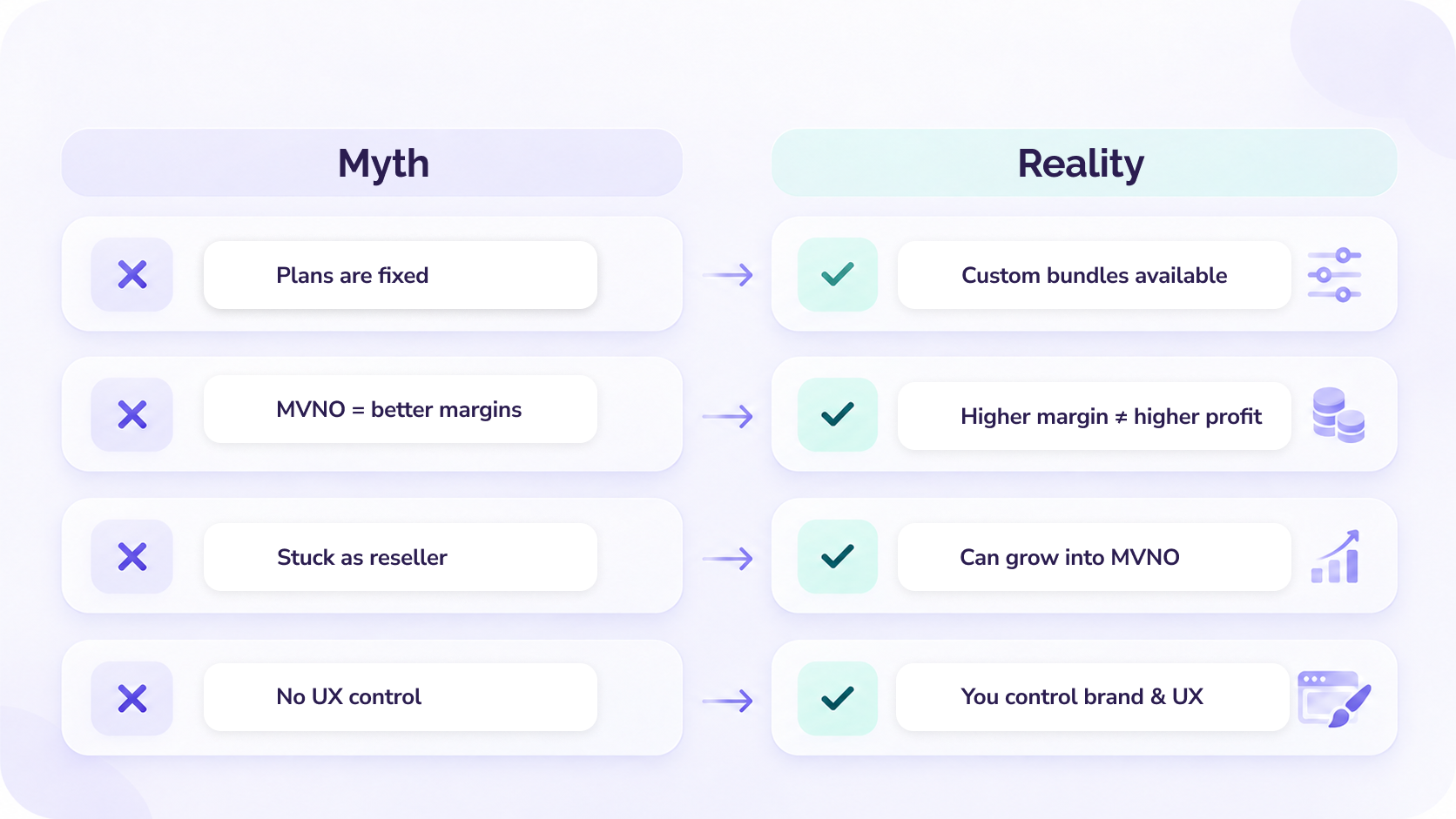
Now that we’ve outlined the main differences, we need to address a few misconceptions. First, some businesses may have concrete objections to becoming resellers, and some programs or models already address them.
They can, but through the MVNO they partnered with. A reseller is the best reference point ot the market. There, esimba.ai will do the utmost to facilitate the implementation of the reseller's view of the market, including creating customized bundles where possible.
While you can find statistics supporting the claim, such data is grossly misleading. MVNOs earn more per customer only on paper, as the comparison shows. That profit is offset by running bills, provisioning, and support infrastructure. In fact, profitability is the main MVNO goal because of these additional challenges.
It’s much simpler for resellers. The only recurring costs they incur are wholesale eSIM prices and white-glove support services, or maintenance costs if your provider created a webstore, app, or mini app for you.
Nothing stops you from changing your business plan. Legal or contractual obligations don’t lock you into being a reseller if you wish to expand. Many businesses launch as a reseller, see what the market actually wants, and build toward MVNO status once there's real data to justify the extra investment and licensing.
Resellers have full control over customer experience. Resellers run pricing, plan design, support, and the purchase flow. MVNOs are entirely technical, limited to provisioning connectivity solutions and ensuring you have enough room to customize as you see fit.
For example, at esimba.ai, we build web stores, apps, and mini apps for clients according to pre-established templates. We usually show them demos, and, if they approve, proceed with development. That doesn’t mean they can’t request certain features or changes, or be able to customize the design, purchase flow, or any other aspect.
Now that we've compared both business models and debunked common misconceptions, there’s the question of what you should do next: be an MVNO or simply resell eSIM solutions. Most of the reasons businesses give for wanting to become an MVNO, like their own branding, control over customer experience, and pricing, don’t require a license. A reseller can offer all three through a white-label eSIM platform, like ours at esimba.ai.
Resellers don’t own the network or billing infrastructure behind the product. They also don’t negotiate with major providers, build their own products, or otherwise change their partner's core business fundamentals. For them, connectivity functions as a stable, reliable source of ancillary revenue.
If your goal is to build your business around connectivity within the next few years and, eventually, offer your own white-label solutions, becoming an MVNO makes sense. But even then, you may end up partnering with us at esimba.ai or another eSIM platform or provider to get strong coverage in your preferred destinations.
Some eSIM platforms are built for only one pathway. We built esimba.ai with both MVNOs and resellers in mind, ensuring each side gets exactly what it needs.
Our white-label services allow resellers to create branded storefronts and get competitive wholesale pricing, applications, and any training materials they need to get started. Our pricing model is flexible, and we do account for seasonality and reward good sales performance with additional perks and bonuses.
For MVNOs, the main obstacle is usually coverage, and we offer a wide selection of data plans and bundles. Made by Keepgo, our platform offers the same bundles and a few partner-exclusive ones, including our voice, text, and SMS bundle, Hercules, and Unlimited and Travel plans.
Partnering with esimba.ai means getting an experienced telecom provider equipped to handle any obstacle you’re facing, and we’re always ready to help and discuss how we can cooperate.
.svg)
As a global MVNO, esimba.ai, a subsidiary of Keepgo, provides you with the opportunity to offer your customers top-quality connectivity in 150+ countries.
.svg)


