.svg)
Powered by Keepgo
Powered by Keepgo
Published on:
July 27, 2026
Tags:
eSIM
Travel
Any travel, backpacking, camping, or even blogging site is very likely to convert its avid readers. eSIMs are extremely popular among travelers, and they save them nearly 75% per GB by skipping traditional roaming services entirely. Companies shipped 600 million eSIMs in 2024, and the market is at its largest today.
In practice, that means monetizing connectivity through eSIM affiliate programs is a wise choice. Travelers want to come prepared for the trip, and you’re helping by completing their experience. But can eSIMs actually function as a secondary income source for the travel niche? Let’s find out together.
An eSIM affiliate program is similar to any other affiliate partnership. You, the affiliate, receive a product URL with a unique tracking code. After you place it and a user clicks on it, the tracking software drops a cookie on their device. If they make a purchase, the brand credits the sale to you and pays you a commission.
Programs differ in terms, and some may have shorter or longer attribution windows (the time after a click before a purchase) and higher or lower commissions. For any potential interested party, the core appeal is the easy setup and zero inventory costs. If you’re currently considering applying for one, you’ll be a good fit if you:
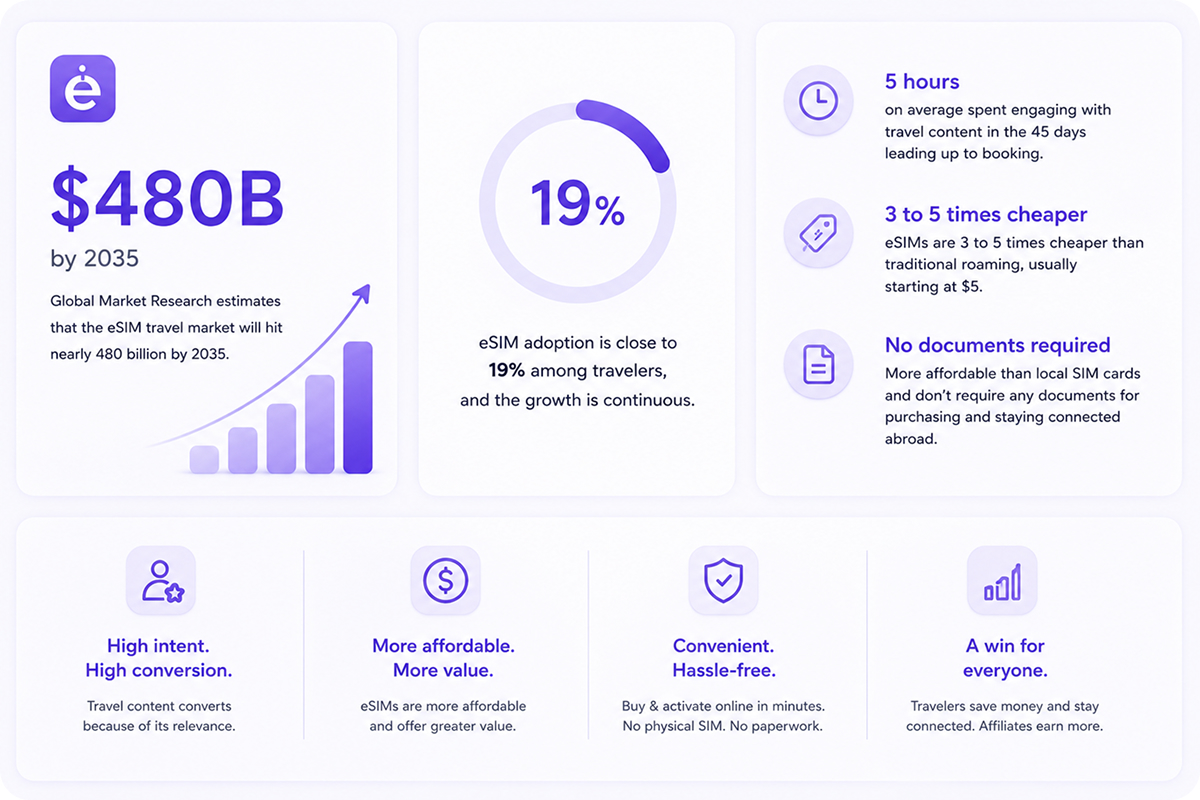
Global Market Research estimates that the eSIM travel market will hit nearly 480 billion by 2035, with many other experts confirming the prediction. eSIM adoption is close to 19% among travelers, and the growth is continuous. But how do affiliate programs factor into this?
Travel content inherently converts because of its relevance. Path to Purchase research clearly shows people spend 5 hours on average engaging with it in the 45 days leading up to booking their trips. For any affiliate partner, that’s a great opportunity to advertise. If the reader, viewer, or visitor converts, that means they liked the content, trusted your opinion, and will become a return customer and help you earn additional commissions.
Price is also a factor, as eSIMs are 3 to 5 times cheaper than traditional roaming, usually starting at $5. They are more affordable to travelers than traditional local SIM cards and don’t require any documents for purchasing and staying connected abroad.
To make it easier for you to understand the differences between various programs, here’s a comparison list of the major eSIM affiliate programs (including ours):
At esimba.ai, our main differentiators are a personal affiliate manager, flexible commission rates, and an API-based referral system. Usually handy for aggregators, you can use our shared API endpoint (/api/get_esim_prices) to pull down the current list of plans, prices, and descriptions as structured data. All you need to do is add your referral code (ref) to the request, and all links will automatically become affiliate.
After establishing a partnership and registering on the travel eSIM platform, the only thing left to do is start selling by actively using the affiliate link. For travel, the most likely scenario is that it will be included in content, either in a video or a blog post.
As we’ve partnered with many affiliates at esimba.ai, we usually see them using our links in:
The way you place the link also affects conversions. As we aim for a high degree of transparency, we usually recommend placement to be contextual and prominent, without feeling too salesy. For content, we recommend contextual and logical placement. Aggregators can create destination pages and provide the relevant bundle information there.
As people trust well-researched reviews, we also ask our affiliates to test the products before including them in content. Any produced video or text should also flow naturally. Here are a few examples for your reference:
The earning potential depends entirely on how you approach affiliate marketing. A single esimba.ai travel affiliate partner can sell anywhere from 3 to 20, or even 50 eSIMs per month. Cumulatively, that allows all our affiliates to make around $3,000 per month in commissions.
If you want to project how much you’ll make as an affiliate, you can try doing some simple math if you have projections. For example: a travel post with 2,000 monthly readers, a 10% click-through rate, and a 4% conversion rate produces 8 sales. At a $25 average order and 10% commission, that's $20/month from a single article.
If you’re planning to start small and have a rough idea of how many eSIMs you want to sell, you can try using our calculator below. It uses the minimum commission of 5% to estimate your earnings.
As we’re interested in establishing long-term relationships with our affiliates, here are a few common mistakes often made by those new to our program.
Although it may seem tempting to participate in multiple affiliate programs, it will only be detrimental to your brand. If you convert a user after they read your content, they have made the connection between the partner’s brand and yours. If any other eSIM provider surfaces, you’re breaking that trust and are actively discrediting any recommendation you made.
This is the most common mistake, but the explanation is a bit technical. Let’s take Google, which scans content across websites through spider bots or just bots. Those bots evaluate the page and put it in the Google index. Once that happens, PageRank, a well-known algorithm, evaluates the links to determine whether you’re endorsing the pages they link to.
When you place an “a href” tag with the link without the “rel” attribute, the algorithm considers this an endorsement. Because this endorsement isn’t organic or natural, it may signal to Google that you’re secretly being paid to promote a brand, which goes against their guidelines. The direct consequence is a sitewide penalty, which affects traffic, positions, and website performance.
To avoid any issues, Google advises adding the “sponsored” attribute to any affiliate link you use. Doing so tells search engines the link is a commercial reference rather than an organic endorsement, which keeps your site compliant with Google's link scheme guidelines.
Any content that is a destination guide or a trip overview video eventually becomes outdated. A post about Thailand written two years ago is no longer relevant for readers, and your competition may have already written something up-to-date. Revisiting top-performing posts once or twice a year keeps them earning instead of decaying.
Another common issue with travelers is that not all of them check compatibility. Not every phone supports eSIMs, but even those that do can be carrier-locked, which blocks a new eSIM profile from installing. If a reader buys through your link, gets home, and can't activate it, that's a bad experience tied directly to your recommendation. So, before using the link, remind readers to check both eSIM compatibility and lock status.
Leading every recommendation with affordable, low-data options is not always a good choice. Lots of our partners’ end users purchase data plans and forget to consider app network usage. Even a series of updates could make it so that their 1GB bundle runs out in 10-15 minutes. But even if it doesn’t, they still may not have enough for their trip, which can cause frustration with you and the provider. Matching the plan to the trip length and data habits you're writing about tends to convert better and generate fewer post-purchase complaints.
If you’re a website owner, YouTube creator, Instagram influencer, or eSIM aggregator that works in the travel niche, we invite you to partner with us at esimba.ai. As a subbrand of Keepgo, we offer the same products as our main brand, with our travel eSIM platform specifically designed for partners.
After registering and finalizing the terms of our partnership, you’ll gain access to the esimba.ai platform. There, you can generate links to each product you offer (we have a tool for that), monitor performance and sales, and even track user transactions. What’s more, your developers can add the referral parameter to an API endpoint call and automatically make all received links affiliate.
Usually, we offer partners 5% to 10% sales commission, but the terms can be further discussed individually. Follow the link below to register and become an affiliate partner.
.svg)
As a global MVNO, esimba.ai, a subsidiary of Keepgo, provides you with the opportunity to offer your customers top-quality connectivity in 150+ countries.
.svg)


