.svg)
Powered by Keepgo
Powered by Keepgo
Published on:
July 29, 2026
Tags:
eSIM
Travel
Ancillary services are a staple in the travel industry. Any agency, airline, or even a travel tech brand wants to boost revenue streams and push profitability. And although it’s easy to find what ancillary services in tourism are, nobody’s trying to explain what businesses are actually interested in: how do they affect profitability, and how do you choose the right ones to offer?
As a travel eSIM platform, esimba.ai has helped many brands boost their revenue through eSIM reselling, a primary ancillary revenue source today. With years of partnership experience, we’re ready to make the case for such add-on services. Let’s discuss what they are, how businesses implement them, and how to measure whether a given service is pulling its weight.
At their core, ancillary services are anything that supports the main product. Let’s imagine a traveler who decides to go on a vacation to Turkey. They’re going to look up the destination and attractions, make a plan, and then start choosing accommodations on a travel tech platform. Anything offered alongside the booking is an ancillary service.
Ancillary services have grown well beyond the handful of examples most people associate with them. They span categories and no longer just mean insurance and car rental.
So, what actually constitutes an ancillary service in tourism? Here are some examples, divided by category:
The mobile travel booking market will reach $612.5 billion by 2031, with a predicted CAGR of 10.7%. A lot of this growth directly ties to ancillary services and how commonly associated they are with any travel brand, and, by extension, their revenue stream.
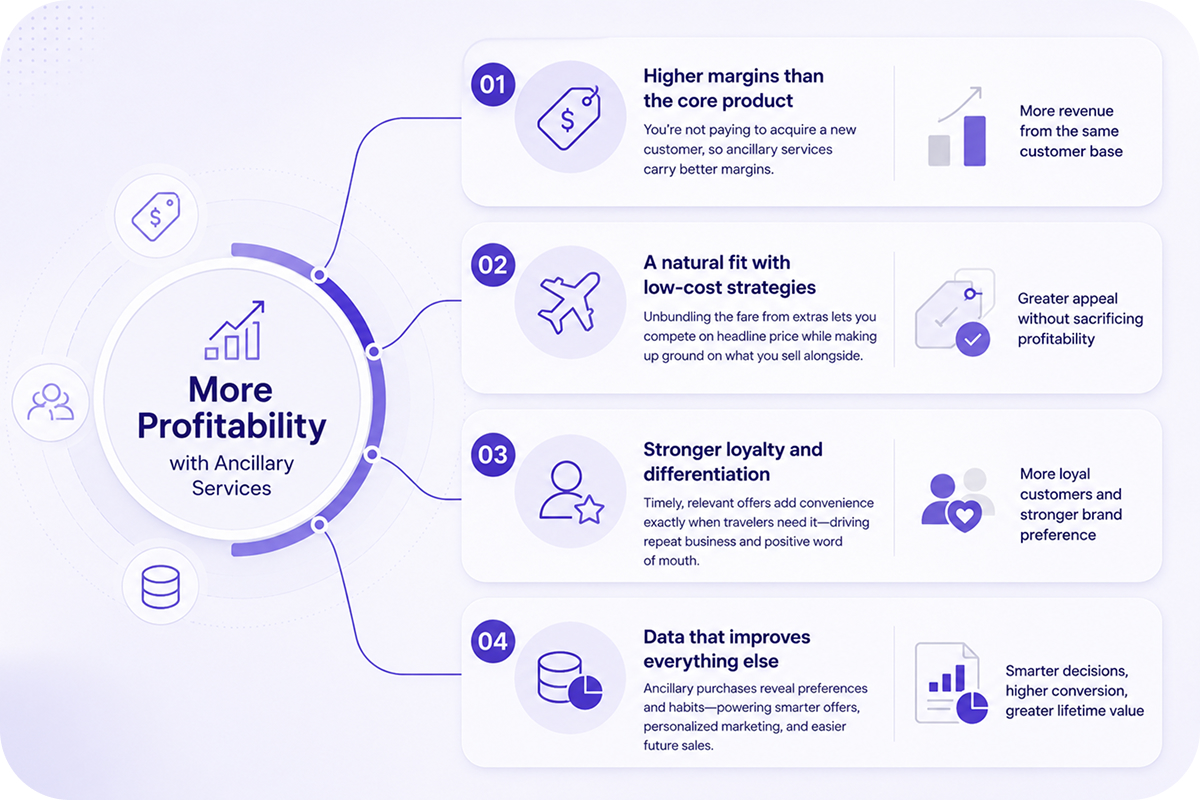
Profitability increases because ancillary services target your core audience, and customer acquisition is not a factor; that’s the first actual benefit. But there are many more:
Another major argument for ancillary services is customizability. A lot of the time, the company worries that adding additional products will dilute their offer and skew perception. And although you can’t necessarily provide insurance through your own brand, you can find fully white-label integration options for certain ancillary services, like with eSIMs.
For instance, at esimba.ai, we can produce a fully customized webstore, a white-label app or miniapp, and even allow you to customize bundle design and data amount. As a result, you can better sell the new product and target niches within your general audience without changing the brand name.
Deciding to offer a service is the easy part. Knowing whether the ancillary spend justifies ROI is where businesses fall short, mainly because they're not tracking the right things from the start. A few metrics make the difference between guessing and knowing:
Before adding a new ancillary service, it helps to ask three questions:
Services that clear all three tend to be the ones worth prioritizing, and the ones most likely to hold up once the novelty wears off.
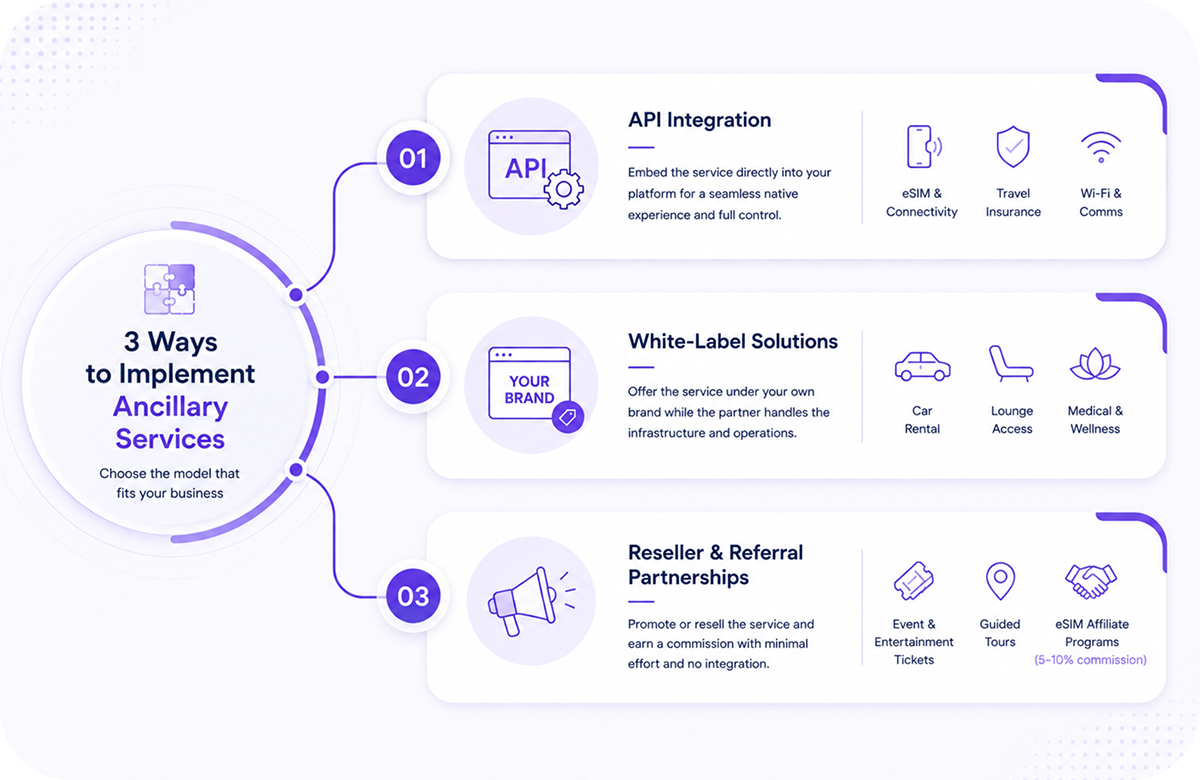
Once a business decides an ancillary service is worth offering, the next question is how to actually add it without disrupting existing operations. In practice, most implementations fall into one of three models, and the right choice often depends on the type of service itself.
This is the most flexible option for businesses that want the ancillary service embedded directly into their existing app or booking flow. It takes more development work upfront, but gives the business full control over how the service looks and behaves.
For eSIM and connectivity, a travel agency or fintech app connects to a provider's API so travelers can activate a data plan without ever leaving the platform (learn more here). Travel insurance follows a similar pattern, with larger OTAs integrating providers via API so a policy can be quoted and added at checkout in real time. Wi-Fi and communication services work the same way, with airlines and hotel groups connecting directly to connectivity providers so access can be offered and billed as part of the existing booking flow.
For businesses that want to offer a service under their own brand without building the underlying infrastructure, white-label is often the faster route. The provider handles the technical and operational backbone, while the business handles the branding and customer relationship.
Car rental is a common example, with many travel agencies offering rental cars "as their own" while the partner manages fleet logistics and local operations behind the scenes. Lounge access works similarly, with airlines and card issuers offering programs branded as their own, powered by a third-party network operating the actual locations. Medical and wellness services follow the same pattern, with hotels and resorts presenting spa offerings under their own brand while a specialized operator runs the treatments and staffing.
The lightest-touch option, where a business simply promotes or resells a partner's service and earns a share of the revenue, with no integration work required.
Event and entertainment tickets are a natural fit here, with concierge services and hotels referring guests to local ticketing partners and collecting a referral fee rather than managing inventory. Guided tours work the same way, with smaller agencies and hotel front desks recommending a local tour operator and earning a commission per booking. eSIM providers also create affiliate programs which net you 5%-10% as commission per bundle sold.
As to the actual margin examples, things can get extremely complicated when we consider all ancillary services. Most companies don’t publish their sales data, nor report on how profitable certain endeavors were. However, what we can do is talk about margins and profitability for our clients.
One of the more representative examples is our current partner, Nikana. We’ve already talked about them in this blog, and their results were impressive. In just 5 months after launching their webstore with us, they were able to make $68,200, with a net profit of $30,328 and a net margin of 44.5%. Initially paying $1,000 for webstore development, they made 30x the investment and managed to achieve an average revenue per user (ARPU) of $18.15.
Although we can’t make recommendations for every ancillary service in tourism, we can attest to our own quality of service. At esimba.ai, we’ve been partnering with travel agencies, airlines, and even MICE companies for years. We have a vast portfolio and a proven track record of success.
By gaining access to our platform, you can enjoy analytics, line management, automations, a deep level of customization, and more. Our main brand, Keepgo, is fully established on the market, with each bundle being carefully curated and developed for a particular client niche, making it much easier to resell after establishing a partnership.
We offer 8 distinct partnership types for every kind of integration, with each one being fully white-label. If you’re thinking about adding eSIMs to your core offer, reach out to our sales team today to discuss options.
.svg)
As a global MVNO, esimba.ai, a subsidiary of Keepgo, provides you with the opportunity to offer your customers top-quality connectivity in 150+ countries.
.svg)


