
Powered by Keepgo
Powered by Keepgo
Published on:
October 30, 2026
Tags:
eSIM
Anyone who’s read about eSIMs is aware it’s a booming market. More and more smartphone models support only digital cards, and many brands, both big and small, already offer them to their clients. Think Revolut, Lufthansa, Trip.com, and others. It’s a trend everyone wants to capitalize on.
The main question is how you’ll do that, and buying wholesale and reselling is one answer. You partner with a provider, and they give you access to their platform, letting you buy their connectivity solutions at special, discounted rates. This gives you more room to profit and opens another sales channel for their products. It’s a mutual win-win scenario.
However, buying eSIMs wholesale is slightly more complicated than you may think. So, let’s dive deeper and find out why.
If you're new to the topic, to truly understand the wholesale method, we need to talk about pricing. Any eSIM price tag from an MVNO, including our brand, Keepgo, consists of 3 unchanging parts. To understand the context behind these pricing elements, we advise you to read through this article.
These parts are as follows:
Following this logic, the retail price is the final amount you pay your provider so they can earn a profit and cover costs. A wholesale price is the same thing adjusted for volume. The difference is that your provider expects you to hit a certain number of units sold consistently and reduces their markup for you when you consistently deliver strong sales.
Usually, wholesale prices are attached to partnerships, like the ones we offer at esimba.ai. You gain access only after becoming a partner, and we regularly review and assess everyone who uses our platform.
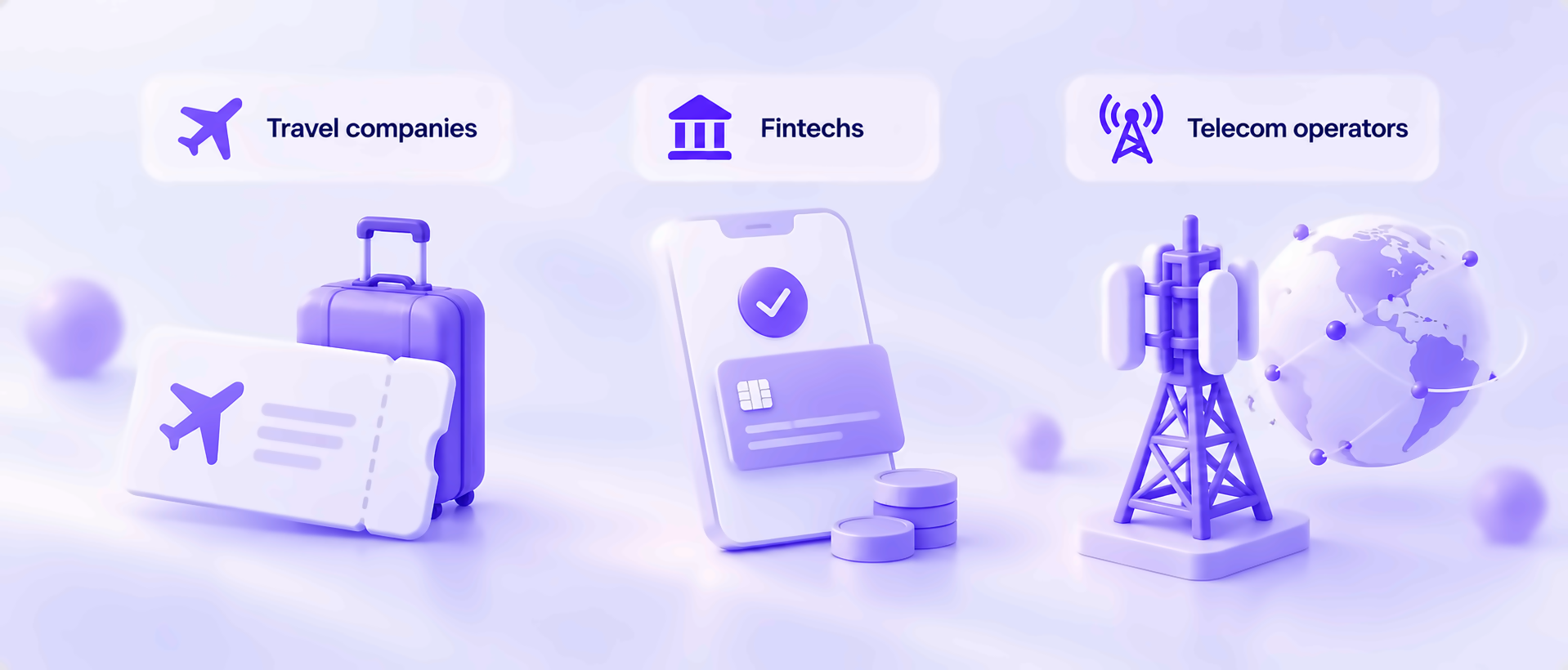
Any business whose customers or employees cross borders can buy eSIMs wholesale. The most common buyers:
This list is by no means exhaustive, and, really, any business can start offering connectivity as long as there’s demand from your core audience
Once you establish a partnership, you become a white-label eSIM reseller, and the operation runs between two parties. You, the partner, and the wholesaler or provider.
The wholesaler buys data from mobile network operators in bulk and packages it into eSIM bundles. It delivers profiles to customers' devices, tracks usage, and processes top-ups. It also gives partners the tools to sell: an API, a ready-made webstore, or a branded app. The wholesaler also handles network-related technical issues.
The partner is any business with customers interested in connectivity. It chooses which plans and destinations to offer and sets the retail price. The difference between that price and the wholesale cost is its margin. The partner owns the sales channel, the marketing, and the customer relationship. Customers buy on the partner's website, app, or booking flow and see only the partner's brand.
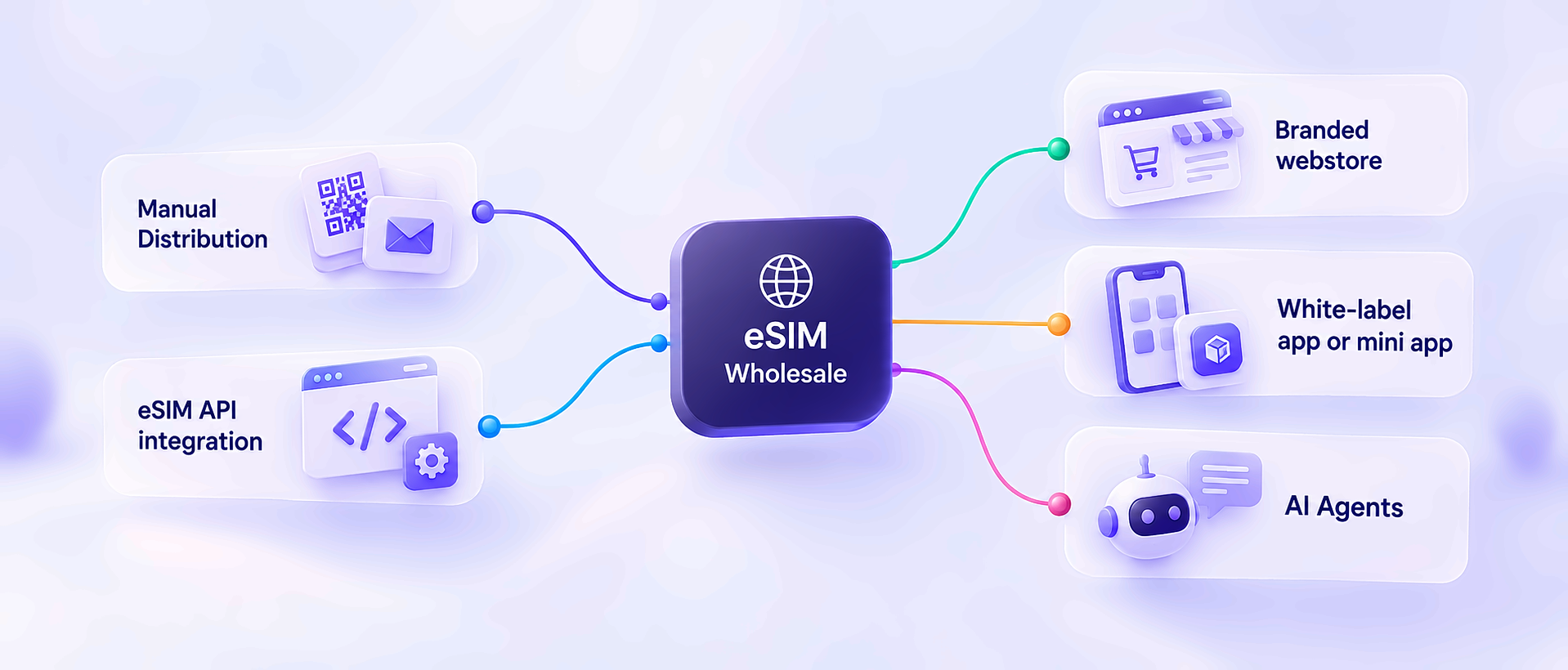
There is no single way to sell eSIMs wholesale. The right model depends on how many customers you expect, whether you have developers, and how much control you want over the buying experience. These models also affect profits, so to get things right, we recommend following our sales tips.
All that said, most partners start with one of the five models listed below.
You register on the provider’s platform, become a partner, and unlock wholesale rates. You then buy eSIMs and distribute them via email or messaging app, or through QR codes you can print and hand to customers.
With an API, your developers connect eSIM plans directly to your website, app, or booking system. An airline can attach an eSIM to a ticket at checkout, and a travel agency can add one to a trip package. You control the full experience and customer data. For example, our eSIM API can issue up to 100 eSIMs in one request, automatically refill balances with a spending cap, and alert your system when a customer's data is running low so you can offer a top-up.
esimba.ai also offers a dedicated sandbox environment. To access it, follow the instructions we described in our API documentation.
The provider builds a ready-made eSIM store on your domain, in your brand colors, with your choice of plans and destinations. You promote the store; the provider runs the technology. It's the fastest way to sell online without a development team. The trade-off is flexibility: you customize within the store's template, and the store runs on one provider's catalog.
A standalone app puts the whole eSIM journey (browsing plans, paying, installing, topping up) under your brand on your customers' phones. If you already have an app, a mini app is lighter: customers open it inside your existing app, with no extra download or second sign-up. Mini apps also work inside messengers such as Telegram.
AI assistants can now search, quote, and sell products in a chat. Connected to a wholesaler’s API, an agent can recommend a plan for a customer’s trip, send a checkout link, deliver the eSIM, and offer a top-up when data runs low. You still set the prices, handle payments, and keep a person on hand for tricky support cases.
If you’ve already decided on the selling method and are evaluating wholesalers, there are some things to keep in mind. Most eSIM wholesale providers promise wide coverage, low rates, and a fast launch, but that’s not always the case. Actually, problems start showing up much later, and to avoid making the wrong decision, we prepared a comparison checklist:
If you’re not getting proper answers, and the provider comes off as somewhat evasive, these are definite red flags, especially if we’re taking points #1, 5, 6, and 7 into consideration.
esimba.ai is a qualified wholesale provider with many years of telecom experience and coverage in 150+ countries. Partnering with us gives you access to nearly all solutions on Keepgo, plus exclusive partner offers like our text, voice & SMS eSIM.
To gain access to wholesale rates, all you have to do is register and top up the balance for $50. In return, you'll get access to our full catalog, and if you top up $500 or $5,000, you'll get a 10% or 15% discount. There are no additional costs beyond wholesale prices or the $50 initial commitment, unless you ask us to develop a turnkey solution, for which we provide a custom quote.
If you have a rough estimate of how many eSIMs you can sell, you can run projections through our calculator. It’s based on our real prices averaged out for your convenience. It should give you a pretty accurate idea. If you require a turnkey solution, don’t hesitate to reach out by pressing the button below.

As a global MVNO, esimba.ai, a subsidiary of Keepgo, provides you with the opportunity to offer your customers top-quality connectivity in 150+ countries.


