.svg)
Powered by Keepgo
Powered by Keepgo
Published on:
July 29, 2026
Tags:
eSIM
Airlines
The travel industry is rapidly expanding, with the World Travel and Tourism Council (WTTC) expecting a 3.2% growth, ahead of the initially predicted 2.4%. The main drivers? Smart infrastructure, sustainable destination management, skills development, cross-border connectivity, and, more importantly, digital innovation.
eSIMs are an intrinsic part of cross-border connectivity and innovation, and more and more airlines offer them to their passengers. Ethiopian Airlines, Wizz Air, and Aegean are just a few of the carriers now selling their own digital cards, right alongside the usual add-ons like extra legroom or travel insurance.
As for passengers, they want an easier way to stay connected abroad and spend more time on the trip rather than worrying about every minutiae. But all these are just a couple of factors driving the shift. The bigger question is whether eSIMs are a genuine win for travelers or a smart revenue stream for airlines. The answer is both, and this article will explain why.
Let’s start with the logical end-users, or airline passengers. If you ever traveled with friends or family, you’re familiar with the difficulties of getting a SIM card. You have to queue with others from your flight at the stands, overpay for the card, and possibly even experience extremely poor connectivity, depending on where you bought it. You can get a SIM outside the airport, but that could involve additional time better spent on something more exciting.
An eSIM sidesteps most of that. A traveler can buy and activate a data plan before they've even left home, so connectivity is already waiting the moment they land. There's no queue, no plastic card to lose, and no need to power down the phone to swap anything out. Some eSIMs also come with phone numbers, making things even easier to manage.
But the most important argument is cost savings, and eSIMs are practically unbeatable in this regard. Juniper Research found that travellers are set to save 75% per GB of data compared to traditional roaming services by 2029. They cited local data routing, digital-first operations, and direct local partnerships as main contributors, and the data is valid, as it’s just as beneficial for airlines.
Most carriers experience low overall profits due to the continuing Iran-American conflict. IATA reports that income is still in the positive, but the net margin shifted to 2% from $4, amounting to $23 billion on total revenue of $1.17 trillion. This leaves some airlines in the income red, and ancillary revenue becomes a possible solution to offset the growing expenses.
As a carrier, you can sell the digital cards for profit, pushing revenue per passenger by 5-10% from the current baseline of $4.5. If used internally, meaning by the airline crew, eSIMs can be 90% cheaper than corporate roaming costs in some markets and extend the same benefits as for regular passengers.
There's a brand angle too. Offering an eSIM at booking or check-in signals that an airline is thinking about the passenger's whole trip, not just the hours spent on the plane. It's a small touch, but it fits into the bigger push airlines are making toward feeling like a travel companion rather than just a transport provider. And brand perception is closely connected to profits.
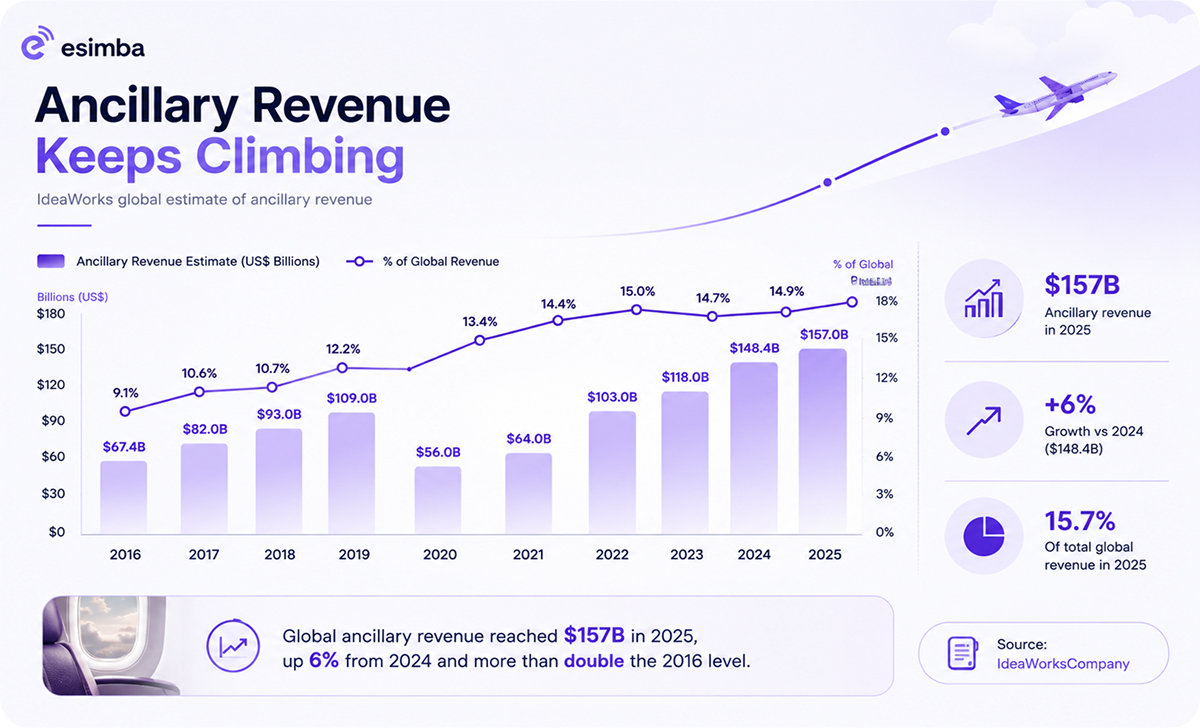
Ancillary revenue has grown into a serious part of airline economics. Industry tracking from IdeaWorksCompany put the total global figure at a record $157 billion in 2025, up from $148.4 billion in 2024, and dramatically higher than $67.4 billion for 2016. Ancillary revenue is about 15.7% of the total income.
But is it possible to project how eSIMs contribute to this? The baseline ancillary revenue is $4.5 per passenger, and eSIM-driven uplift is 5-10%, which means airlines get $0.225 and $0.45 per eSIM sold. Getting back to the IATA report, they expect slightly more than 5.1 billion people to travel this year. If we make it an even 5.2 billion, then eSIMs can bring in $1.17 billion on the lower end, and $2.34 billion on the higher end.
As a share of total ancillary revenue, that would put eSIMs at roughly 0.75% to 1.5% industry-wide. This means that airlines can sell to their existing customers at no additional acquisition cost, and push their revenue up by a significant amount.
The case for eSIMs is strong. Demand is already there; passengers are buying travel eSIMs anyway, and you can capture that spend through your own channels instead of losing out to third-party apps. You’re differentiating your brand by offering connectivity and expanding your offer.
But even with all this data, it doesn’t mean an airline eSIM program is a guaranteed win. Coverage and network quality still vary by region, and passengers tend to blame the airline brand on the box, not the network behind it. Device compatibility isn't universal; older phones and some regional handset models still don't support eSIM at all. And by partnering with an outside provider, an airline is putting a piece of its customer experience in someone else's hands.
There's also the question of uptake. Not every passenger segment cares equally. A business traveler on a short international hop is a very different buyer than someone flying domestically, and airlines need to be realistic about which routes and which passengers this actually resonates with.
None of this rules out the opportunity. It just means the decision deserves the same scrutiny as any other ancillary product.
Now that everything is clear, you may want to embed connectivity into your core offer. There’s more than one way to do this:
But no matter the integration method you choose, there’s one aspect you carefully consider: choosing the actual eSIM provider or partner. And, at esimba.ai, we’re very confident we could help.
Partnering with esimba.ai means choosing an MVNO-backed platform with a wide range of capabilities. Carriers can monitor purchases, measure profits, review analytics, configure automations, and customize each data plan, from the design to the desired data amount.
In turn, that allows you to better segment your clients and use your usual channels to boost your ancillary revenue figures. Even if you don’t customize, our default bundles were created with each possible travel customer persona in mind, and you can choose from a vast selection of plans, including our eSIM with a phone number called Hercules.
If you’re interested in establishing a partnership or just want to explore options, don’t hesitate to contact us. Our sales team will be happy to answer all your questions!
.svg)
As a global MVNO, esimba.ai, a subsidiary of Keepgo, provides you with the opportunity to offer your customers top-quality connectivity in 150+ countries.
.svg)


